24 May 2012

Just what the Doctoroff ordered

main link
So much is written about China today for the typical western capitalist who mainly wants to know just enough about the Middle Kingdom in order to exploit its growing middle class of consumers that it can be a challenge to separate the hot air from the hard sell. The increasing volume of this kind of writing demands that it be considered its own genre. It is, therefore, often interesting to take note of the development and form of this increasingly pervasive literary phenomenon.
Tom Doctoroff, whose looks and career path might be the model for Don Draper, if Don Draper had gone red and dared to work for the Commies, likes to write books while he is not trying to convince western consumer brand merchants how to make lots more money selling in mainland Chinese. And when he is not pitching ad campaigns to marketing execs who are itching to get a piece of the Middle class Chinese pie, he is writing articles to promote his books and, by extension, himself.
A recent piece that he managed to get positioned in Forbes looks and reads like a powerpoint presentation that was quickly reworked by the journalist/contributor/columnist/freelancer, Kenneth Rapoza, to meet an impending deadline. I suppose I ought to cut him some slack. He covers Brazil, Russia, India, AND China. That has to be exhausting while based in New York City.
*Look, the article even retains the 10 bullet points from the original PPT! Which is double cool if the writer is paid by the column inch.But to Doctoroff's credit, it is so much more convincing to get somebody else to spout a salespitch on the pages of a prestigious publication than to directly shill on assorted media outlets. Or as they say in the  boardrooms: Booyeah ^5! I bet incidental product placement never felt so good.
After Rapoza makes note of how the market insiders play off the blips and flips of composite shares, he goes through the list of Doctoroff's factlets and morsels of wisdom based on his stint in China, the purpose of which is mainly to continue to persuade potentially wary international brands to set up shop in China and consequently to seek out the services of his advertising agency.
The 10 points that he ticks off are vague platitudes that seldom put Doctoroff into a corner that he won't have to weasel his way out later. In the first example, we are told:
Myth No. 1: Popular anger means the party’s power is weakening
The communist party, despite its heavy hand, “has street cred.” Unless growth collapses, citizens will grudgingly support national leaders. The Chinese people crave order. Stability is the platform on which progress will continually be built. In the future, a more Singaporian model may take hold but one thing is certain, the future of China’s political system will not be made in America…or Europe.
Singaporian?  How far into the future is Doctoroff willing to assert that mainland China may imitate the high end retail mecca, education hub, and tax haven that Singapore represents? But he boldly avers that it won't be similar to models from two other areas. (Singapore is a parliamentary republic with a legal system based on English common law.) Because everybody knows that to build on something it only needs to be stable and well understood, maybe. After his first insight, we learn that Beijing is creating a pathway to the world wide web with Chinese characteristics.
Myth No. 4: The internet will revolutionize China
The internet is changing China and mostly for the good, but revolution is too strong a word.  China’s digital era remains uniquely Chinese. Beijing allows for a blank canvas of self expression and material gratification, but retains the veto power to control public discourse as it did when it threatened to shut down the Sina Weibo microblogging service over theories about the political dramas surrounding politician Bo Xilai and later with Chinese activist Chen Guangcheng. Internet users may grumble, but they’re not ready to rumble.
But the online revolutionaries will still be eager to buy diamond tennis bracelets and Heineken in cans. Doctoroff assures his intended readers of marketplace stability by so narrowing defining revolution. In spite of how the internet has revolutionized every other society through greater access to information, news media, business connectivity, and so forth, Doctoroff is certain that the PTB in Beijing are still ready to crackdown if anything starts smelling of jasmine tea.
Myth No. 5: The Chinese market is too much like Europe 
(Is this a myth that he just pulled out of his ass so he can shoot it down as a talkingpoint?) The rest of the quote is:
China is as unified a country as is the U.S., despite its wide geographical and political differences. The challenges of unifying distribution networks, sales channels, retail presence and sourcing standards “remain monumental”.  But it is operational hurdles that make China a Balkanized economy, not cultural or political differences.
So China is unified (in some undefined sense of the word) in spite of it political differences but the political differences are not what make China Balkanized. So does he really mean to say that it is a myth that China is too much like the former Yugoslavia? But how does he explain how the monumental challenges of unifying (but isn't China already unified?) all the necessary operational elements that international retailers want in a large, say, common market with a single currency, which China is not too much like, have come about? Could they possibly have been put in place and maintained by provincial level politicians, you know, due to differing political motives?
And in describing his astute observations of the particularities of the Chinese consumer we get this nugget:
Myth No. 6: The Chinese consumer is inscrutable
 Women want to reconcile achievement and traditional feminine grace and therefore prefer to buy diamonds that sparkle, but don’t have too much bling. 
 Yeah, that's totally right. Chinese women want the diamonds that sparkle. They certainly don't want the diamonds that don't sparkle and they must have just the right amount of bling. Say, around 10 bling per carat. And as for the men and their bling quotient, we learn in the rest of the myth's knockdown:
Men want to show they’ve clawed their way to the top without showing off so prefer an Audi or BMW to a Maserati. Once foreigners appreciate China’s unique characteristics, their tastes become easier to understand.
Because the only way to explain why more Chinese men buy an Audi, or BMW, instead of an equally affordable Maserati is that only those brands have the unique characteristics that Chinese drivers want. Don't you get that, foreigners?
Other myths are equally vapid and stand for easily knocked down strawmen.
Myth No. 8: China Inc. will kill U.S. jobs
Doctoroff can assert this with some degree of impunity because he is only talking about the future of job killing by China Inc. The US jobs that were moved from North America to be filled mainly by Chinese peasant women willing to work under sweatshop conditions so that corporate balance sheets and executive bonuses could go stratospheric, those jobs were roundly killed and buried in the past. But killing still might bother the few remaining corporate decisionmakers who aren't complete sociopaths. Some of them might have misgivings about China's militarism and how it might affect profit loss statements. Doctoroff is the charmer with a homespun folksiness that he might have learned from a Booth School of Business seminar on feigned rustic sincerity.
Myth No. 9: China will be the lone world superpower
China does not inspire hearts and minds like America does.  American dignity for the common good touches hearts. China is chauvinistic by comparison. In ways large and small, its instinct to narrowly defend its self interest is off putting and isolating. China will be an economic power, but not a culture or political power. There will be more than one tiger on this mountain, and the other will be the good ole U.S. of A.
Doctoroff could have mentioned the efforts by Beijing's Politburo to launch a softpower campaign and how its effectiveness has been negated by the overall lack of appeal for authoritarian regimes. Beijing had big hopes on bankrolling a film that they were convinced would get an Oscar due to the undeniable tragedy of its theme. When the film failed to entice moviegoers to the cinema or to garner an Oscar nomination, the response was in some quarters to insist that it was proof of antiChinese bias in western media.
There is an odd theme in the last three of Doctoroff's myths. He is constantly assuaging that his readership has nothing to fear from a wealthier China with a stronger industrial base and a strong desire to acquire more things to kill citizens of other countries with. Lastly he points out:
Myth No. 10:  China is militarily aggressive
China is ramping up its military, but will never use it to challenge the U.S. or invade its neighbors.  For a credible analysis of China’s modern fighting force, scour Pentagon briefs. But to get a sense of Beijing’s pacifist instincts, come for a visit. The Chinese shield themselves from danger, both real and imagined. This is not a culture itching for war.
Given how incredibly wrong this last statement is, I think it is not so much that Doctoroff is in slick salesman mode, using glib euphemisms to pepper his pitch. He (as much as Rapoza equally buys into these memes) sees China in the same light that many neocon hawks regard US imperialist actions as blameless regardless of the negative results. It's the kind of thinking that can allow Bush 43 to declare himself a wartime president but never admit that he was the aggressor in those wars, or as he put it himself so succinctly:
"I just want you to know that, when we talk about war, we're really talking about peace."
This last myth also contains one of the few examples when Doctoroff is unqualified in limiting his pronouncements about China. He says never will China use it military to challenge the USA or invade it neighbors. Never can mean two things when it is used by salesmen. It can mean not until he, at least, is dead, or more typically, not until after he has moved on to a higher paying job. We can all hope Mr. Doctoroff enjoys a long life, but we can still have reason to doubt his credibility. It was only only 1979 that Beijing saw fit to punish the nation of Vietnam in retaliation for ousting the Khmer Rouge, China's ally at the time. (On a personal note, if there were ever an argument to be made for using military force to oust a foreign regime, I think this is a strong one.) Tensions have continued with occasional border incursions, occupation of disputed territory, and very renewed tensions accompanying Chinese increase in naval capacity over the Spratly Islands. As many right thinking thinkers who claim citizenship from the good ole USA, it is not considered aggression when the nation is bad. So attacks against Vietnam by China can be overlooked just as the USA can define terrorism down whenever it seems to promote the US foreign policy agenda.
Yet it is still harder to reconcile Doctoroff's claim of Beijing's pacifist tendencies with the country's history of territorial expansion and border incursions. It's not at all useful to visit the Forbidden City to get a sense of this because that is precisely not where the evidence of Beijing unpacificistic actions are occurring. Even if some want to ignore what Beijing does against Vietnam, it's harder to ignore its bellicosity when it bumps up against putative US allies like Japan, the Philippines, Taiwan and other Asian nations regarding the Spratly islands. The BBC has produced the most eyecatching map that reveals the extent of Beijing's desire to avoid war close to home soil by extending a really broad shield as far from the mainland coast as possible.
One possible interpretations of Doctoroff's myth busting strategy is that he simply does not want anybody to look behind the curtain of the all powerful Oz. Much of salesmanship is helping potential customers to forget about what they ought to be mindful of. The audience for his books, and his well placed interviews, and articles are those brand name executive marketers who have yet to infiltrate the mainland Chinese brand awareness. The more they don't know plays into Doctoroff's strategy of reassuring them that he above all other admen knows everything that needs to be known about the Chinese consumer. Doctoroff is on a roll with his latest literary oeuvre and if he manages to win over even one high end brand that he can represent in mainland China, then his job skills and sales acumen speak for themselves.  


15 March 2012

The Chinese 1%ers and Those Who Fawn over Them

Main article

I think Damien Ma grants Eric X. Li (李世默, Li Shimo. I have no idea where the X. comes from.) far too much credibility with his analysis of his editorial in the NYT.  (Does every venture capitalist get invited to post whatever he wants on the pages of the newspaper of record? Has the old gray lady sunk to the level of the steadily sinking Huffpo?) Even as Ma rightly concludes that Eric Li's ideas are "unformulated and inchoate", he asserts "Li, and other emerging voices like his, deserve to be watched." And I suppose that I can equally assert that an approaching train wreck merits watching, too. But I would only say that in order that we learn how to avoid further trainwrecks, not because there is anything of value in trainwrecks.

I come from a different perspective, having been tasked with teaching composition to young Chinese students whose parents' greatest ambition is to send their progeny abroad to earn a diploma from a western university. I have slogged through so many similarly written essays that I find nothing in the style nor content worthy of comment on other than perhaps to point out that Eric X. Li has managed to parlay his way through a western education without it improving his writing style in any way. His daddy's dream was afterall that his son get a diploma, not strictly get an education.

The lack of logical coherency, the unsupported claims, and the exaggerated sense of importance are fully on display in his essay. As Stanford maintains its mandate to open its doors to privileged offspring of all races, creeds, and private clubs, we witness more the growing similarities between the Chinese 1% with their American prototypes. And just as in the same way that a man who habitually insists on eponymously christening every building he classes up with gilding and mirrors can get a gaggle of reporters to quote him and seem interested, "the Eric" has his own cheerleaders and sycophants who act as though they can comprehend whatever deep thought he pronounces: here, here, and this guy.

I am not going to pick apart Eric Li's essay here. Somebody else at Chroniclinghate with more idle time on his hands than I has already gotten down into that gutter. I never saw much value in redeeming such essays even when I was paid to do so. Just to be clear, the arguments of the essay are far less important than their placement. Acknowledgement by the NYT is what every venture capitalist needs to grease the wheels of China's bureaucratic institutions and sell whatever business plan he and his cronies can cook up. That's for the Chinese readership.

What those without any interest guanxi can gain from this piece is unclear. The essay reads like a piece of satire, intentional or not. There is always doubt in my mind whether conservative thinkers understand when they are the object of satire. Stephen Colbert's viewership, for example,  is full of the types whose ideas and sacred cows he regularly gores, but for them it's all a hoot. So I was pleased that James Fallows tipped me off to this bit of pointed skewering. I suspect that the elder Mr. Li will enjoy learning about yet an example of how much attention his bilingual son gets in the international press. Gan bei!

25 January 2012

Soft Power Blowback

The NYT recently published an essay by Joseph S. Nye, Jr. The odd timing of its appearance is a bit curious. Nye did a round of media appearances to promote his most recent book, The Future of Power, early in 2011. For the man who is given credit for inventing the term, soft power, it seems that the NYT editors are behind the curve. None of this is to suggest that there are any faults with Nye's essay. He is spot on in his interpretation of soft power in today's socio-political discourse and he aptly applies it to China. He doesn't, however, suggest why China is so incompetent with its soft power appeal. I want to suggest that the PRC sabotages its best efforts by its top down approach and by, seemingly, patterning its campaign on Chinese pedagogy.

The modern mandarins are under the impression that they can package and launch an attack of soft power; 'shock and awe' rendered as 'cool and wow'. Nye cites the 2008 Olympic summer games, and the Shanghai expo, but as much as even the central planners want to convince themselves as to how effective the Expo was in promoting brand China, it was much more of a domestic affair. The Chinese attendees learned far more about urban living in the many national pavilions than foreign nationals learned about Chinese methods of crowd control or mascot selection. And yet in spite of spending more money on the 2008 summer games than any other nation has spent, the number of foreign tourists went down during in August, 2008 because of Beijing's desire to predeport all potential troublemakers, even those who had purchased tickets. Nye argues that any gains from hosting the games were undone by the subsequent crackdowns in Tibet and Xinjiang. Events in those regions might have been juxtaposed in the media at the time, but the situations in these two regions had been longstanding black marks on China's international reputation. Internally what deflated even the proudest of jingoists was the melamine milk contamination and the subsequent revelations that the health warnings and the prosecution of the perpetrators were delayed until after the end of the games. So there was a lot of buck with very little bang and hardly an echo. Other publicity fiascoes can be mentioned, but the pattern is apparent and shows little sign of improvement.

Soft power comes in many forms, the least effective of which is when a nation tries so blatantly to promote its agenda, using soft power. Today the most effective modes are the forms that a national government has the least control over such as in the fields of athletics and entertainment. By contrast, Voice of America was once an effective tool of statecraft in many parts of the globe when it was the only form of information that countered state propaganda. Not only has the internet decreased its influence, so too have, to a much greater degree, pirated DVDs of feature Hollywood films, AV porn, and HBO blockbusters. Postings with Chinese subtitles done by volunteers within 24 hours of domestic broadcast can be watched by millions of viewers. HBO's Boardwalk Empire is but one example.
It's possible to cite contrary examples to this premise such as the Apollo program (NASA is one of the most visited websites in the world, ranked 778 according to google statistics.) and the Marshall Plan and certainly those who were effected directly by such efforts will never forget them. In spite of those government directed activities, I think it is fair to say that Kobe Bryant and Lady Gaga are far better for US soft power than Neil Armstrong, or George Marshall ever were. Walt Disney has undoubtedly done more to promote the USA as a force of goodness than any State Department program.
Another example of the Chinese soft power push is through the spread of Confucius Institutes. Their effectiveness is difficult as yet to measure and they are not without their share of controversy. India has refused to allow them. But for every little gain brought about by the Confucius Institutes' good will and ample cashflow, the heavy handed control from Beijing undoes it. A far more effective means of spreading its soft power is Hanban's placement of subsidized Chinese language teachers in diffuse institutes of secondary education.This is still a rather new program with equally difficult to measure results, but that is why, in part, it is called soft power. According to the law of unintended consequences, I can equally foresee it as a vehicle for promulgating the soft power messages of other nations as a result of the many Chinese language teachers who reenter their homeland and reacclimate to their classrooms with firsthand experiences abroad.
Plush toys at the vanguard of soft power offensives

Chinese soft power launches an awkward fashion moment on the diplomatic front!

Getting back to the premise of this posting, I feel that the best way to understand why the soft power push by China fails miserably is to consider the source of their methods, Chinese schools. The role of a teacher in a Mainland Chinese classroom is to enter the students' space, stand at the front of the classroom on an elevated platform, and to speak at the students, who do their best to remain attentive and to be passive vessels of knowledge. The students are expected to study all the information in preparation for regularly scheduled tests. The teachers are explicit as to what information will appear on their tests. Contradictions, inconsistencies, and even the purpose for having to study the material are dutifully ignored by the students who hope to succeed in this system. Chinese educators teach to the test for in China that is the only purpose of teaching. Some voices have questioned this method and yet theirs is the exception that defines the rules. Teachers who fail at getting their students to pass their tests are regarded as failures, themselves, which is why many are not above teaching their students how to cheat on their tests. If enough teachers can turn the process into a profit by selling cheating hardware, then are they to be blamed or the system's emphasis on results over procedures? The money to pay for such devices certainly did not come from the students' working part-time jobs.

The CPC fashions itself as the teachers in this campaign and consequently wants the rest of the globe to behave like good students according to their definition by accepting Chinese culture as strictly defined by the authorities in Beijing. The official curriculum, the setting, and what gets ignored are determined from above. This is a one-way approach with only one acceptable answer to any topic. Continuing this analogy, one can easily enough comprehend its shortcomings. The whole system survives and perpetuates itself only because the colleges entrance exam, gaokao, has such an important role in determining one's success in Chinese society. And if the students don't recognize this fact, the parents anxiously normalize the next generation to the system. But the rest of the world's students and sinophiles are not bound by fear of failing on a test; they do not feel compelled to remain silent in the classroom; nor have they certainly any hesitation to criticize the prescribed curriculum's shortcomings. Progressively as more about China becomes better understood outside China, the students will demand to know even more. Will the teachers lose these students or adjust their pedagogy? As Nye sums up his piece:
The development of soft power need not be a zero sum game. All countries can gain from finding attraction in one anothers’ cultures.
The most positive conclusion that can be drawn from this development is that in the end, the soft power assaults and counterstrikes will benefit all parties, from the front line troops to the civilian populations. For the longer that China engages in its efforts, the more the CPC will be forced to recognize the counterproductivity of its present strategies. It will become more evident to even the most intransigent residents of Zhongnanhai that more can be gained by undoing bad acts than by overspending political capital on soft power with Chinese characteristics. Simply freeing a few well known political prisoners will generate more good will than hosting yet another international sports event. Multiple battles to restore the environment will conquer more than constructing another maglev line. As unthinkable as this idea seems today given the extreme nature of Han Chinese conservatism, geo-political expediency will inevitably prevail. On another front, as more thought is invested in how to effectively teach the Chinese language to foreigners, the improved approaches can have crossover benefits within China's school system. In the past neither the Chinese people nor the rest of the world gained in the slightest whenever the leaders of China closed off the country in both directions. Soft power, on the other hand, breaks down barriers and facilitates communication. It is mutually beneficial for all combatants. And as long as China has the drive and resources for this kind of combat, I cannot complain about the increased fallout of peace, love, and understanding.   


11 January 2012

Dystopia

Tyrell Corporation, Shanghai, Nanjing Lu, Replicant Research Division


Shimato-Dominguez Corporate Headquarters
I've seen things you people wouldn't believe...

01 January 2012

Timberframing in China

Yangzhou is a tourist destination within a day's journey from Nanjing. I had an opportunity to spend a few days in the city last October, 2010. I had wanted to travel there for several reasons, yet it was only by happenstance that I was able to come across some examples of modern Chinese timberframing and am now finally able to post the images that I was able to collect.
There are many very old buildings in Yangzhou, and remnants of old buildings. The difficulty as with much of China is distinguishing the old from the made to look old upgrades. There are to be sure some impressive, extant examples of Yangzhou's past. Ge Yuan is one notable site. This streetscene typifies much of what charm Yangzhou offers.
The paved streets and walls of grey brick give some indication as to the amount of wealth that flowed into Yangzhou at one times. The salt trade, rather the collection of taxes, on the salt trade accounts for most of the wealth that flowed into this once worldly city. From what I saw there is no reminder of this commodity's importance.


The city even had its own perimeter defensive wall yet only this one remaining gate is a testament to that.  Further developments make it impossible to see the extent of the original defenses. The gate has been beautified and rebuilt so much that it is a pale representation of Chinese military architecture.


And because even the oldest parts of Yangzhou are still a very much inhabited, it is possible to walk down its many narrow alleyways and find sights such as this, modern construction pressed up against the old with a mixture of modern amenities and destructive alterations. In all cases of historical relics, it is happenstance in what determines what is preserved and what is lost.


One is just as likely a beautiful gem of detail as a modern metal door as its replacement. This motif does not appear to be Chinese, but I have no experience is such matters and it is doubtful that the present residents can offer much accurate interpretation either.

Within close proximity of the above, one can find examples of much lower quality and preservation. And yet I argue that this architectural example reveals as much history of the place even though its interpretation is equally problematic. It's a mystery that it even remain standing. There is something almost intentionally sloppy with the mortar repairs and even though some attempt was made to afford a decorative elements to the upper corners of the entryway, the mason used a segmented lintel against all sense of utility.
I cannot say for certain whether these two doorways are contemporary, but they exemplify how appearances and methods can vary across time and between craftsmen.

Here is an exposed example of the timberwork of an older building near where much new construction is underway. The roof structure is simple yet elegant. The bottom chord rests on the posts in open mortises, tying the opposing walls together. Two queen posts support a straining beam with a mortice that accepts a king post, which is in turn morticed in a ridge beam. Purlins carry closely spaced splitsawn timbers as rafters. The whole assembly carries interlocking fired tiles set in mortar.
Not far from this original historic building is this structure that attempts to recreate, at least in appearance, what was probably demolished to make room for it construction. It will be used to extend the amount of retail space for the sale of trinkets and travel souvenirs, which line most of the pedestrian venues in old Yangzhou.


Here is a closeup of the modern interpretation of Chinese timberframing. It features the use of rounded timbers and some of the same joinery. There are, however, some changes. While the purlins are carried on the king and queen posts, they do not appear to involve any joinery. As can be seen, the purlins are simply cut flush at the ends and butted together atop the posts. I can only guess that they are toenailed or will be connected with some sort of other metal fasteners.


In this image, it is possible to see a wider gap between the purlins. It is difficult to ascertain what is happening at the ridge line.  The kingpost does not seem to be engaged into the ridgebeam, but instead it is attached to sawn lumber pieces upon which a round ridgebeam rests. This kind of connection seems to not rely on traditional joinery, perhaps as a concession to modern building codes or simple expediency. It is rather high up and out of eyesight.


As another example of expediency, there is this shim where a mortise was cut too deeply into the top of a post for accepting a tiebeam. Every good craftsman knows how to correct his mistakes and this might be evidence of a relearning curve. The timberyard is just a stonesthrow away.


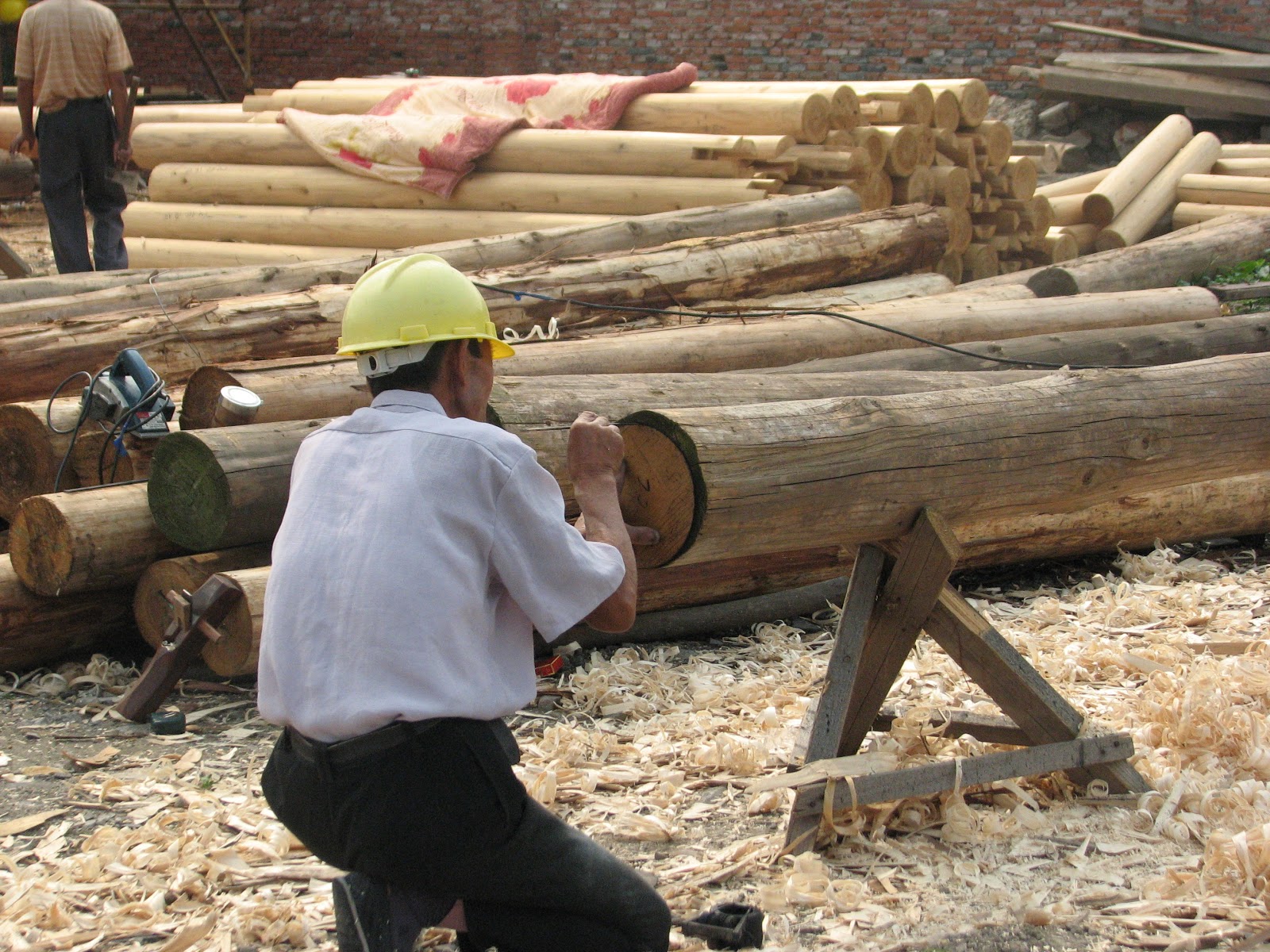
In another concession to modernity these men use an electric chainsaw to cut a raw log flush at one end. Behind them is a stack of partially worked and unfinished timbers.


In the next step, a workman lays out the dimensions of the timber, using a template and ink. Afterwards he uses a single beveled hatchet and planes to smooth the timbers to their final rounded dimensions.


A pile of finished timbers await assembly. A few are marked with a general description of where they are to be placed. 中栋东 means nothing more than "Middle Support East" The bases show the centers marked in ink where an anchor pin will be used to secure them to pedestals. It is possible to see the two interlocking mortises properly cut on the tops of the posts, the deeper one accepting the lower chord onto which the tie beams are placed.
These are the handmade tools used by the man above doing the layout, lying on some raw logs. The horizontal handles seem to be a feature of Chinese planes. Cheaply made planes of bamboo and Vanadium alloy blades of similar design can be bought in retail stores. This plane body was built of a dense tropical wood and had the heft of bronze.
A workman uses a similarly handled plane with one hand holding the near end of his stock and the other end against a backstop. I cannot say whether this awkward stance is considered best practices by the other timber framers. I can say that on most construction sites that I have visited, the workbenches are flimsy pieces fabricated from scrap lumber and constructed to last no longer than the present job. Unsurprisingly, I, therefore, saw no benches on this worksite other than some crudely built brakes and horses.


Back at the new construction site posts rest on their pedestals, not of stone but brick piers with a cement overcoating. This seems like an odd manner of cutting costs since the piers are so close to eye level and the fact that stone is widely used in China and so is readily available and with many workmen who can fabricate it into more traditional pedestals. A stainless steel pin is anchored into the concrete upon which the posts is dropped down.
This historic structure managed to survive demolition.  It is hard to ascertain its original function with many of its surrounding buildings removed and the clear evidence of many alterations. It does though stand as a remarkable survivor, an example of the refinement and craftsmanship of Yangzhou traditional architecture. 

31 December 2011

Restorative

Wushang Gaungchang is a rebuilt commercial area located in Hangzhou. It gives a taste of what old China was like to satisfy the touristic desires of modern Chinese and foreigners alike. Most of it is all new construction, which is a testimony to both the degree that traditional Chinese architecture has suffered and to low standards for heritage conservation. I did, however, spend a bit of time venturing behind the newly constructed facades of Hefang Jie to get a glimpse of some more hopeful signs of what can be done with enough care and attention to the past. More often than not historic buildings with an even greater pedigree are torn down.  In the video at 0:56 it is possible to spot a hastily spray painted character in a white circle, 拆, which is shorthand for demolish. It is a common site in all Chinese cities. I have a background in restoration so it was remarkable to witness the slower, more deliberate efforts on maintaining these buildings. I enjoy finding positive developments in China. I took these photos in 2009 and have not been back to Hangzhou since.

The above photos gives a good sense of the nature and methods of construction. I cannot date when these structures were originally built. It is possible to see the combination of post and beam construction with the major members still in the round along with sawn boards and plaster lathe to fill in the voids. The one wall in this case is of common red brick with a mortar overcoat. The roofing material is made up of grey overlapping clay tiles. The tarpaper seems to have been an attempt to lessen the discomfort of these draughty buildings or a sign that at one time the residence was subdivided.
These two workers unwittingly posed for me. It's possible to see a single beveled hatchet in hand that is used to remove the waste from the mortises that one is sitting on. The plane seems to be handmade or passed down through the generations.
In another section, two more workmen are assembling timbers. The scarf joint on the right hand side stands out as an example of their craftsmanship. It was undoubtedly cut with the bowsaw that rests against it. The posts rest on a carved or turned stone plinths.
A closeup of another scarf joint. I see no evidence of any mechanical fasteners on these joints.

Another workman lays out the mortises on another timber, using an ink brush and a very light square. An off-centered tenon cut to fit and match up flush with one side of a round post can be seen.
A view from the courtyard reveals the state of the original workmanship. Original woodwork stands out as darkly oxidized in contrast with the newly placed vertical pine paneling. The delicate tracery of the banister molding shows loss. The various pieces might be for disposal or to be part or the reassembly. One leg of sawhorse rests on the pile.
Looking up at the second floor walkway from the central courtyard, it's possible to see the degree of loss and one step in the restoration process. Along the dripline can be seen the decorated ends of the clay roofing tiles.


A close-up of one area where the woodwork seems to have suffered very little damage. By eye, it looks to be machined applique in this case. A beaded edge highlights the arris on this and many wooden elements.


Here a stonemason cuts the design for a drain cover. I have seen many examples of this kind of onsite work being done in China when one might expect it to arrive finished from a quarry.


Lastly there is this image showing the construction of some of the buildings in this area. This exterior wall consisted of random use of stone and brick masonry covered with a thick sort of daub onto which was applied a smooth plaster coating. The effect was to give an appearance of solidity and uniformity.

14 December 2011

Word Empire Idea

Thorsten Pattberg has recently been making an impression in a few media outlets with an essay in which he attempts to assign blame for the lack of Han Chinese philosophical contribution to western imperialism and bemoan the barriers of arrogance against accepting Chinese terms into a worldwide lexicon. He supplies a few quotes and some examples, but in the end, it's his unwritten motives that stand out and not his linguistic persuasiveness.
Pattberg frames his essay this by pointing out that the general terms in Chinese used to denote philosopher, democracy, and civilization have different connotations than their equivalents in western languages. There can be no dispute that history, context, and usage can have such an effect on the meanings of words. Pattberg simply chooses to ignore what every thesaurus makes clear and pretends that he is as ignorant as a casual reader.There are many words in any language that can be found to have no exact equivalents in another. This is not new nor exciting to anybody who has looked at such matters. Definitions can even vary between native speakers across generational, class, and regional lines. This is the reason why dictionary entries are ranked by number in order of most common usage. Exact correspondence from one language to another is not controversial. It only becomes a controversy when a lack of overlap between terms in one language and another becomes a kind of sticking point upon which one can skewer an innocent strawman.
"I estimate that there are over 35,000 Chinese words or phrases that cannot properly be translated into the English language." It's impossible to know what to make of such a number or what to make of what it means to properly translate a word. Adding "phrases" to the number of untranslatables is a qualifier that lets him off the hook of accountability. He might be alluding to Chinese Yanyu 諺語, proverbs, often in a 4-character phrase, called Chengyu 成語. Dictionaries exist to compile these expressions and to explain their meanings. Even the Chinese can be confused due to the truncation of phrases taken from literary sources. But the purpose of Pattberg's essay is not about how to understand Chinese nor the challenges of translation.
Pattberg checks off his points by attempting to overwhelm most readers with their lack of knowledge of the Chinese language. He then makes the following claim: "In many countries, adopting Chinese terminology is a taboo." If it is a taboo (or is that even the right word?), then how can he have mentioned earlier in his essay the adoption of Chinese words into English. "Words like yin and yang, kung fu and fengshui.", words he claimed were all untranslatable. He seems to suggest a kind of circular argument: words are untranslatable when they are borrowed directly and therefore not translated. I wonder what Pattberg's definition of proper translation is. And in how many countries exactly is it taboo to say: tea, typhoon, gung-ho, soybean, or kowtow? Has anybody felt the need to refer to a one-handled, iron pan for stirfrying vegetables euphemistically lest he cause others to blush?
It took me a few readings to understand why I needed to reread this essay so often. Pattberg is an academic but, or because so, he is an inferior scholar. By this I mean that he wants to construct an essay well enough to make himself appear like a viable candidate for an academic post. I suspect that he really wants a permanent position at Beida. It's probably also why he wrote his book, which even now has only gotten one comment on its googlepage. In fact, his writing style reads like so many essays by Chinese students that I have had to edit. I suspect that his intended audience is the Peking University faculty selection committee.
The essay ends with an appeal that we all adopt Chinese terms as part of a larger discourse, specifically, minzhu (democracy), wenming (civilization), and shengren (philosopher). Yet there is no reason given as to why such terms ought to be adopted or how anything can be gained by doing so. Some languages are very conservative when it comes to borrowing foreign terms. e.g. Icelandic, Chinese; whereas, some languages are promiscuous with incorporating foreign words. e.g. English, South Korean.
In more adoptive leaning languages, words are borrowed when speakers and writers decide that a foreign term has advantages. Two examples pointedly bear this out. The word guanxi 关系 has gained a foothold in English to describe relationships inside Chinese society and between businessmen. Its general meaning of connections, or network with hints of cronyism and nepotism made its adoption useful in describing guanxi's overwhelming importance within the context of China. It remains to be seen whether guanxi might used in a general sense.
Another way for a language to borrow from another is with a calque, an overlapping of words from one language onto another's. The founding of the People's Republic of China was a heady time of news ideas and bold political energy. For those people who lacked the obligatory revolutionary fervor, techniques were developed to persuade them to conform to the right-thinking manner of the new ruling power. The Chinese term for this is 洗腦, xinao, or literally 'washing brain'. Directly from this wording along with knowledge of the technique the calque, brainwash, entered the English language.

Pattberg bemoans the lack of Chinese terms in a wider discourse while he ignores evidence of words that have entered general usage. He simultaneously interweaves bits of China's humiliation narrative into a poorly constructed thesis on comparative linguistics, beginning the essay with the assertion that he earns the charge of "culture treason" for highlighting such injustice. For the record, words are borrowed from the Chinese language when there is a need, not simply because doing so might help a postgrad curry favor with his Chinese academic advisors.