14 May 2009

Early Modern Chinglish: 101

There is a name for every regional variation of English brought about by local conditions, historical migrations, and interactions between other language groups. Singaporeans refer to the occasional loan words and some syntactical influences notably from Chinese as Singlish. And I am certain that many PhD dissertations have been written just on this one variant. Such variations can also be used to justify Canadian English and Australian English dictionaries. These such variations, however, occur in all sufficiently large sampling of speakers of any living language.

This should, nevertheless, not be confused with a relatively new phenomenon known as Chinglish. One might be tempted to suggest that Chinglish is akin to a pidgin language, which emerges when different speaking groups want a simple means by which to quickly engage in commerce. They feature reduced inflections, and simplified vocabulary and syntax with deference to the dominant group’s linguistic features. Chinglish is solely the product of the Chinese educational system. English is typically introduced here in the third grade. Its inclusion came about when the central government in Beijing mandated English education for all students in China as part of the national curriculum, commencing some time after the opening up under Deng Xiaoping. Relatively overnight Chinese students put their noses to the grindstone and began preparing for the subsequent tests that would evaluate their ability to study for tests thereafter focussed on English grammar and translation. Often the tests are simply badly translated passages that require the students to translate the English text back into the original Chinese.They also often feature multiple choice questions for which the students must choose which one of the two or three possibly correct answers the examiners want the students to select.

So for every newly identified phenomenon, there quickly arise postdoctorates hoping to develop enough expertise to justify landing a tenured position. A center for advanced Chinglish studies shall likely take root wherever Dr. Michael Erard ends up teaching. I bet he dreams of the day when he can get out of the freelance business and start going to department sponsored mixers and draw upon his two years in Taiwan as a cultural anthropologist, disguised as an out of work English graduate teaching ESL in a cram school.

In an article that appeared in Wired, he speculated as much as his unshaven face and glasses can lend gravitas to the profundity of his thinking about the future of communication in English, implying that Chinglish was somehow part of the ongoing evolution of the English language. The man does have the paperwork to prove that he studied linguistics, which might explain how well the doctor can embarrass himself in so many languages. Being a jack of all languages and master of none, Mr. Erard’s main skill is getting published, anticipating the academic dictum of publish or perish demanded in universities. For true Chinglish scholars, I offer for the following adage in the target language: Make article or be died.

I can convince an audience of native Chinese speakers that Chinglish is not, in fact, a phase in the evolution of English but simply a dialect (albeit loosely defined) of Chinese itself. Bluntly, it is nonsense to suggest that Chinglish is anything more than sloppily and poorly translated Chinese idioms replete with misspelt and invented words, which, in its worst manifestations, cannot even be understand by Chinese speakers themselves. At a minimum, it requires a general understanding of Chinese grammar and the common faults of English education on mainland China to be understood. One advantage of having linguistics enshrined in places of higher learning and treating it as a profession is that it can offer some advantage to general society. Wouldbe faculty members like Dr. Erard (MA Linguistics, PhD English) who keep themselves busy by finding stuff to fill column inches and bookcovers with while they plot about how they can best convince others that they understand better than another candidate marketably arcane topics are on today's pathway to the ivory towers.

By the way,I hate to be pedantic but rest in peace in Spanish is properly ‘descanse en paz’. Dr. Erard, if you really want another job in an institution where competent scholars really do study other languages, you ought to redo the epitaph for your uncle. But it might be forgivable. Selection committees love creatively pompous selfdescriptions like yours:

"A linguist by training, I'm a writer by birth. [...] The transition from academia made for the second most profound year of my life. I'm committed to marrying narrative power to specialist knowledge, and to helping produce a more mature discourse about language in the US. I'm also committed to doing so accurately, responsibly, and creatively." 1

Nobody can fault the man's verbal creativity, especially when it comes to the booktitle.

There is yet one more contender for the head of a Chinglish language department. Who knew that there could be so many selfappointed scholars in this field? But as they say in academia: the competition is fierce because the rewards are so meaningless. Herr Oliver Radtke in the tradition of Teutonic linguistic methodology wants to record every single instance of Chinglish for posterity and further academic inquiry. At least, he wants to keep publishing books on the same theme. Referred to as a German sinologist, Herr Radtke’s main skill is being sly about his motives for producing photo collections that go straight to the marked down table. It’s really a bargain at $7.95!

Referring to the incomprehensible examples that can be found on everything in China from warning signs to plagiarized homework assignments, Mr. Radtke makes a plea for the conservation and the academic scholarship of Chinglish. He asserts as one does when polishing a doctoral defense to a a committee conditioned to be culturally aware:

"I'm trying to challenge the notion that there is only one type of standard English - the English that's spoken in America or in the British Isles - which is shortsighted, because Chinglish is already being used by millions of people to communicate with one another."2

One of the hallmarks of an academic researcher in search of tenure today is how he claims to want to challenge the very same system, which he eventually hopes to become part of. One type of standard English? Whoever proposed that there was even a standard to begin with. It was a professor I had in university who made it clear that English, unlike other languages with language academies to prescribe orthography and usage, but which inevitably fail in the task [pause for knowing tittering], English has no such institution that sets its usage standards. My classmates and I, of course, dutifully wrote down his words and accepted them without question.

As any businessperson from outside China who does business inside China via email can relate, Chinglish is indeed used for communication. It doesn’t, however, mean that such communication is ideal or regularly clear. I cannot claim with certainty, but I think that in dealing with Chinese traders, many foreigners imitate the Chinglish patterns in an effort to streamline their communication and to feel more assured that the meaning is not lost on the Chinese side. This has the unfortunate result of normalizing the Chinglish in the minds of some Chinese speakers.

The claim that millions use it goes beyond reasonable credulity. Native born Chinese speakers themselves don’t use it other than to help them pass examinations or to lend cachet to places of business. It's not used for communication as much for decoration. The same garbled menu tomes exist in mainland China, too, even in restaurants that might never be visited by a nonChinese speaker. Almost invariably, the mainland Chinese ignore any English words whenever the Chinese script is printed next to it. (Enough competent English speakers exist in places like Hong Kong and Singapore so that errors are more likely to be weeded out by conscientious civil servants and businesspersons.) In trying to understand why public signage intended to communicate to nonChinese speakers would so consistently produce incomprehensible examples such as: Calculate Experiment Base. The answer that best explains is that miserly managers want to believe that when any English words are used, the foreigners can figure them out. Optimistic to say the least.

In many academic circles, semantics has become a dead end for one’s career. It’s just too difficult to stake out an exclusive corner on accuracy and meaningfulness; whereas, interpretation and symbolism can be the ticket to lifetime employment. It is in this vein that Herr Radtke hedges a bit in his defense of Chinglish as he did in his interview.3 He quickly backs up from defending the nonsensical and incomprehensible, claiming that nobody wants to do that.

He refines his goal, instead, to wanting to preserve the new expressions to “Stay off the grass” which he regards as trite and believes that the English language could use some refreshing with the Chinese alternatives. Is it necessary to even include this as Chinglish, "Little grass has life, please watch your step" since there is so little meaning lost with the more verbose expression; whereas, with "wash after relief" it is not clear as to whether it is an admonition to flush or to wash one’s hands. He is far more intrigued by what the word relief culturally says about taboos regarding corporal functions. I am certain that an entire seminar can be held somewhere about this topic and how the Chinglish can be used as a starting point to explain the workings of the Chinese language. Such an erudite discussion is definitely not, however, on the mind of a foreign traveller who has just learned the hard way that Chinese public restrooms are commonly not supplied with toilet paper or soap. There is in his appeal to preserve Chinglish, a subtle nod to any future selection committee that Herr Radtke is well aware of the different norms and practices of foreign cultures. There must be an endowed position for him somewhere! Because as any department head of an American university knows, it requires a foreigner faculty member to teach properly about cultural presumptions and insensitivity.

Simply put Chinglish is just one aspect of my work that makes my life as an ESL teacher in China more complicated. Its ubiquity reinforces what I seemingly in vain struggle to undo on account of the English teaching practices used in China. It also reinforces itself by suggesting that there is no need to use English as an accurate means of communication. It is just there for an abstract purpose. It is something that must be studied because it is part of the curriculum that insures a Chinese student a bright future, right next to Maoist economic theory. But one should not tell that to the experts in Maoist economic theory. So often in education, it’s not what or how well you know any subject, but whether you can find a job teaching it.

When I first noticed this sign resting on a baby grand in a coffeeshop near where I work, my best guess told me that it meant: No Tipping the Invited Player. In fact, it means: Do Not Play the Piano.

Does Dr. Erard see this as a kind of missing link in the evolution of English?


Does this example of Chinglish add spice to Herr Radtke's understanding of how it can represent "something more creative and more local"? Is there anybody other than himself who feels that this garbled translation does anything more than to confuse the meaning of the more universally understood glyphs?

07 May 2009

Sugar spinning


Wushan Guangchang lies on one end of Yan’an road opposite the very upscale shopping hub of Wulin square. Lately the area has been undergoing extensive amounts of refurbishment the quality and authenticity of which I want to observe over the coming year since it seems to be handled better than other urban renewal projects in present day China. On a recent visit there, I happened to come across some street entertainment amongst the usual hawkers, whom I had not noticed during my previous forays. The main activities and little boutiques, some vintage, others made to look vintage are along Hefang street, a pedestrian thoroughfare with many diversions to amuse even the most jaded or jade seeking tourist. Some ancient looking apothecaries dominate the corners, but the majority of shops sell silks, tea, and trinkets. Without any attempt to downplay its presence, McDonald’s doesn't do much to blend in with the setting's theme.
I came across two candymakers while strolling there with some students. What struck me was how the candymakers were selling the candymaking as entertainment even more than the sweets. I was amazed at just how easily the two artisans made the tasks look. Having worked with sugar in the past, I wondered how they could maintain the sugar at the proper temperature to do what they did. I could only think of Antonin Careme and his five stages of cooked sugar.
The first that I saw was a young man making candy tracery on a stick. The majority of his customers were young and so he had cleverly placed a wheel with a pointer to spin in order to get them to make a design selection. Then the candymaker would dip into a pot of sugar at hard crack stage maintained on a small electric hotplate. Letting the sugar drizzle, he drew the selected design over his worksurface, placing a stick halfway through his effort, but still with only one dip into the sugarpot. At this temperature and concentration of sugar, it is so very easy to burn the sugar or to have trouble maintaining humidity. I wondered whether an additive might have been mixed in with the sugar in order to lengthen to working time and how long the mixture could be allowed to sit on the burner. The same candymaker made candies whenever a customer asked for one. The spectacle of one piece candy being made would subsequently draw in more customers. Then more sugar would be drawn out of the working sugarpot. I didn’t see any backup pot to know what would happen if the raw material started to run out.

The young customers get just as much pleasure from watching their candies made as from eating them.


A few paces down from one candymaker saw another woman who made what can seemingly be best described as taffy. There she also drew from a simple pot that was thermostatically controlled without much apparent concern or oversight.


She would pull out a measured amount of the sugar with two sticks and spun the mass with a third stick, just as with a taffy pulling machine. Not only did this allow her to work air into the concoction, but she would also add tiny amounts of dye that went into the zoomorphic shapes that she had on display.

19 March 2009

Christmas Lunch at Dragon Well Manor


It has been overdue for me to write about my actual visit, albeit delayed, to the Dragon Well Manor. I was given the opportunity to dine there after being invited by a student to experience what it had to offer us and her colleague.

My dining experience was heavily influenced prior to our lunchdate by the New Yorker essay by Fuchsia Dunlop, which was the initial motivation for me to seek out the restaurant; otherwise, I and my fellow diners would likely never have heard of this destination restaurant. At the very least, I would not have been able to strongly hint that I wanted to pay a visit to such an establishment.

Our private room awaited us. A simple table set for three and watched over by a large print of Zhu De. The barest of table service was laid out with three bowls of amuse-gueules to stave our hunger until the meal began: dried cherry tomatoes, unsalted peanuts in the shell, and assorted rice cube candy (dou mi). I thought of coining the term, tomato raisins, which, in fact, I think I just did. Some painted tiles added color to the otherwise dark table and austerely padded chairs. Tea was immediately poured into lidded mug to help alleviate the late morning chill. There was a sideboard where the waiters would do the staging of the various courses. We strolled a bit before being seated by the head waiter and presented with a menu composed of vertical bamboo strips. My hostess and her colleague read and chatted with the waiter and I sat back and waited for what was to come. I am not certain whether my companions ordered a la carte or whether this was the menu de degustation for the day. I asked to look at a wine menu which seemed appropriate given that this meal represented Zhejiang haute cuisine. I selected a 2005 St. Emilion grand cru. The headwaiter showed me the label and then proceeded to divide the bottle into three glass pitchers. The Chinese have a certain protocol, insisting that all members drink the same amounts of alcohol. As it was, my two companions at the table offered me most of the contents of their pitchers by the end of the meal.

The first course was a bowl of warm soymilk with condiments: sugar, dried tiny pink shrimp, youtiao (chopped strips of deepfried batter), chopped pickled green chilies, soysauce, chopped green onions, a yellow pepper salsa, and unskinned peanuts. This is basically what most Han Chinese call their breakfast on any given morning: doujiang or warm soymilk. The rather bland or neutral soybean gets something to help make it palatable. And for reference, it went well with the French bordeaux.

The next wave of courses came after the first was cleared away. Normally platters come haphazardly in a Chinese restaurant. This locale was showing itself as different. To save tablespace, the kitchen served dishes on raised, footed platters. Set before us were deepfried fish soaked in vinegar, mutton sausage with fivespice powder, and pressed tofu (dofu gan) in a cloudy broth. The waiter then brought out the famed leather booklet that showed the sources of all the ingredients and the delivery times. There were photos of rustic farms and traditional animal husbandry in practice. Sadly I could only look at the photos and imagine the kind of details that were shared about the suppliers of the day’s repast.

The headwaiter then brought out a poached duck that had been simmered for four hours. After showing it to us and telling about its background, it was brought back into the kitchen to be segmented. The bowls arrived with equal portions of ginseng, steamed duck, and cicada larvae that were in the original cooking crock. I don’t think the cicadas added much of anything to the flavor. We were also served a scrambled egg dish that was mixed with lots of chives. It reminded me of the medieval tansy.

The headwaiter spent a good deal of effort in answering questions and explaining the background of the meal as I expected based on The New Yorker article. While this approach to cuisine with an emphasis on local and seasonal ingredients is still avant-garde in the USA, it is revolutionary in the PRC. Dare I say counterrevolutionary even? Food culture is still trying to shed the communist mantle that insisted that a chef feed simple foods for the working masses. Thinking toom much about the pleasures of food was a luxury of the old regime and a bourgeois affectation. So this restaurant has taken upon itself to engage the diner in a kind of voluntary reeducation, to rediscover flavors and to join the international slow food movement. There is already a national chapter in one part of China. In spite of their best efforts, however, the wineglasses were far too small for the red wine that I chose. They were uniwineglasses, I presumed, that are used for serving reds and whites. The assistant waiter as is typical in China hovered and tended to overfill the glasses as though any of the three of us might at any moment challenge the other two to “Ganbei!”

The headwaiter then brought ought a mature head of bokchoy and showed us the insides by pulling off the outer leaves. We were then served a platter of these same “hearts of bokchoy”, lightly sautéed with a hint of sesame oil. Then arrived a seafood broth medley: abalone, seacucumber, scallops in a dense chicken stock. In amongst the recognizable bits there were gelatinous marine things and what appeared to be shark’s fin.

We were then served another soup that seemed to be made from squid and its own ink. I believe that it is called laroutang. Forthwith were placed in the table a platter of boiled pork and eggs, sautéed chicken heart with bamboo and red chilies, ham and bamboo in a light broth, steamed white rice, small, darkened pickled cucumbers, a dish called dofu qizi.

Then arrived the birdsnest soup sweetened and flavored with what seemed to be peach tree resin, niangao in a caramelized sugar syrup along with more of the niangao in an eggdrop soup that was oversweetened with what tasted like raw sugarcane juice, xiaoxianzi, and a carved fruit platter of melon and kumquats.

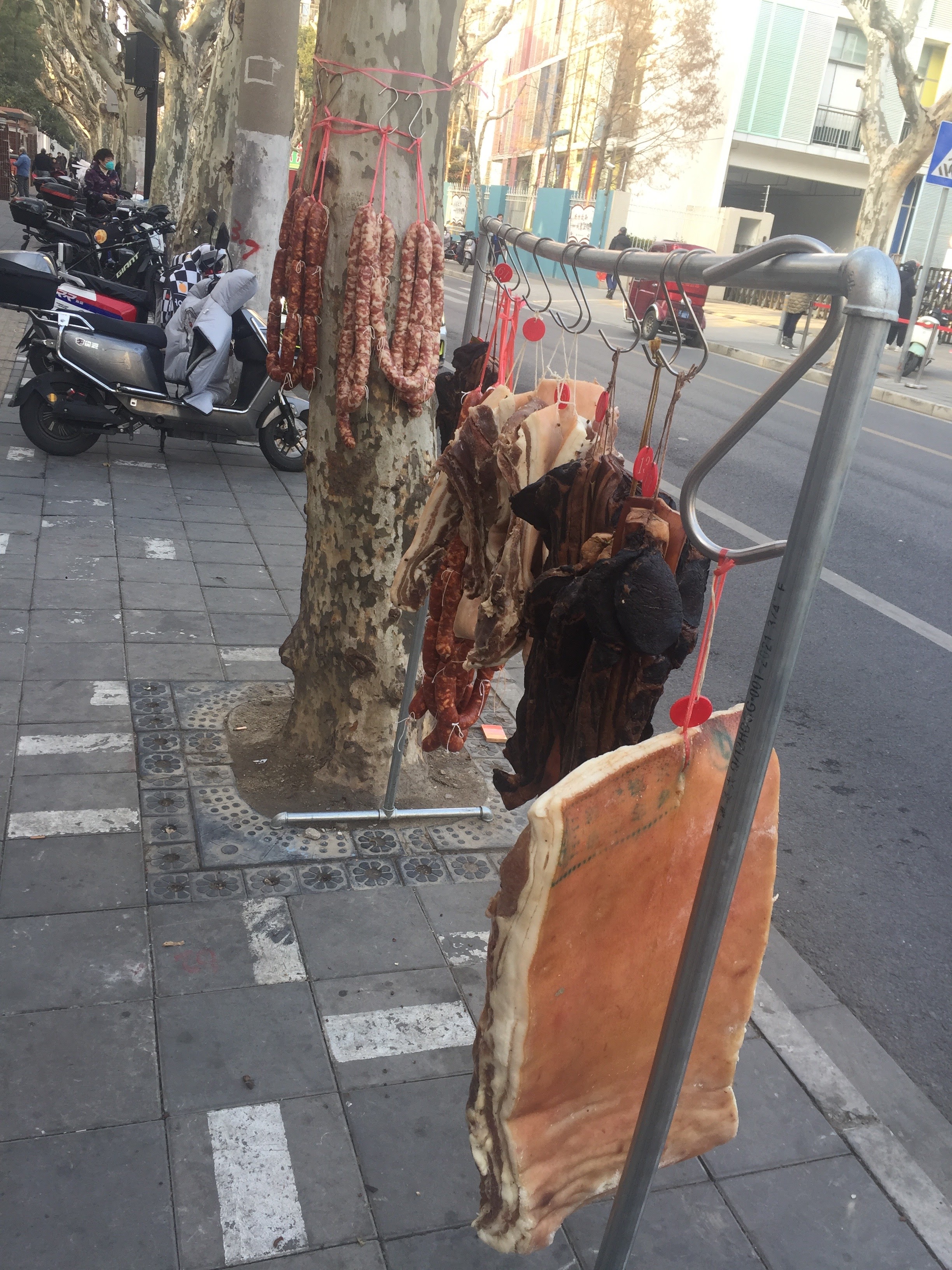
It was as we were exiting the diningroom that we were all able to observe the cooks at work making the fresh niangao and their dried pork and poultry for Chunjie. It was a mild afternoon by then and I could see the advantages to working outdoors even though the usherettes and the parkinglot attendants stood in their quilted overcoats. A gentle, arid breeze wafted through the rafters drying and curing the pork and ducks that seemed to have been hung out as part of the seasonal preparations after being dunked in a dark brining solution.

14 February 2009

Sino Italo Bistro


Henry Yang Shigang was a freshman in Heze University, Shandong province when I first arrived as an ESL teacher in the PRC. He and his close classmate Owen liked to pull me aside me during classbreaks in the hallway and chat informally. More casual conversations often occurred this way than in the classroom. My feeling at the time was that each student wanted his own foreigner to speak English with privately. It annoyed me, especially during the long empty silences while I tried to lead a lesson, but it seemed better than the absolute silence that I encountered with some students. I was frequently asked about how to study English better, how to get a good accent, and sometimes, how to find a good job. It didn’t take me long to realize that the answers to such question would not come from studies at Heze University. When Henry asked me what he ought to do for his future, I told him to strongly consider leaving that school and finding another means to make his own path.

I don’t know what about Henry’s character and family background enabled him to consider and then to follow my advice. He himself sought out an agency to find him employment in Singapore and negotiated with his parents to fund the venture. Chinese parents tend to be conservative and they are inclined to help their children attain the highest level of education possible. For about the past 30 years and throughout most of Chinese history, a high education was as much a mark of status as a means of class advancement. The present state of Chinese education has undone most of this historical pattern. And to be honest, while most Chinese students know that they are not learning anything in their universities, many feel entitled to enjoy the break in their studying regimen and more sadly, they are often incapable of making decisions on their own. They do not learn critical thinking skills that could help them escape their own educational downfall.

Henry is different, but in some ways he is simply smarter about being himself. While he wants what most all of his peers want, he is better at breaking from the crowds of who want to achieve the same goals and by doing so in lockstep diminish the likelihood of successful outcomes. We were not able to meet on my first visit to Singapore. He had decided without telling me that he would upgrade his working conditions. To do this he needed to return to China and reapply for a work visa. When we finally met, he had been working in his second job there for about three months as a waiter in an Italo bistro.

During our first meeting outside his native China, we strolled near where he worked at his first job. He started out his career, working in a kitchen located in a museum in a former colonial structure that has been annexed to accommodate films, multimedia exhibitions, and live performances. We sat down and enjoyed coffee and a slice of the lime cheesecake, lounging on frameless chairs. He gave an invitation to go a nightclub to meet a colleague on the eve of the lunar new year. There I met Jek, the name he goes by in Singapore. He holds a degree in food and beverage management from a college in the Philippines. It was he who finally urged Henry to invite me for lunch at the restaurant.

I wanted to arrive as early as possible since I needed to be at the Zhangyi airport by midafternoon. I arrived with a good friend by taxi, suitcases in tow. The restaurant is located in Rochester Park, a former residential retreat on a thickly treed hill that has been converted into a series of upscale restaurants. I arrived and Henry offered me a cappuccino and I looked around the otherwise empty restaurant. The kitchen was open to the elements as were the majority of table settings. A plate glass roof littered with fallen leaves covered where we were seated.

The menu was typical Italo food, the international amalgamation of the various regional cuisines: pizza, pasta, and prosciutto. We started with a platter of antipasti misti. There were all the ingredients that made it look like a dish that people who had not closely studied Italian cuisine might feel comfortable identifying as authentic. There were slices of melon wrapped with shaved ham, roasted bell peppers (thankfully peeled), a slice of eggplant and another of zucchini both bearing light grillmarks but unsalted. There was a handful of salad of wild rocket, a tougher version of the more delectable arugula. I have grown this type of green and while it is a true Italian green, it does not serve itself well as a fresh salad green. There was a pesto and a drizzling of oil over the assembly. The oil was pomace grade and the pesto seemed to be made of parsley or some other bitter green, perhaps more of the wild rocket. Lacking garlic, pinenuts, parmiggiano, or salt for that matter, it was insipid and added little more than extra calories to the dish. There were two mozzarella balls that had been frozen and for some inexplicable reason, the plate also contained a few slices of preserved pink salmon slices.

I had ordered a glass of the house red and asked Henry to bring it with the pizza. An Australian Shiraz arrived just before the pizza. It had a pleasant nose that was not enhanced by the diminutive wineglass that it was served in, yet it was overoaked and needed time to regain its composure. I accepted Henry’s recommendation for the pizza selection. It arrived with a minimal crust: marina sauce, loads of shaved ham, baby shiitake, and white cheese. The restaurant had just acquired Italian pizza ovens and Henry told me that the staff was still learning how to use them. They were placed behind an exterior wetbar on the adjoining patio. Good baked bread is hard to find in Asia, European bread, that is, bread with a crust that requires chewing and that has flavor from multiple risings. The weakness seems to be the lack of hard wheat flour in the doughs. In an effort to compensate for the low quality bread, the headchef seems to have decided to overload the toppings. It was essentially tomato sauce with meat and cheese on a big round cracker. In fact, I have tasted worse pizza in mainland China.

Pizza has become an international dish, and being so it has been homogenized and reinterpreted by local tastes and foreign economic forces. I now forget which of the owners of the restaurant and the associated specialty food outlets throughout Singapore, the husband or the wife is the Italian. But it really doesn’t matter since having left the homeland, and abandoning the guidelines of whichever regional cuisine, generations of Italians have let the local market inevitably determine the outcome. This restaurant would fail in short order in any corner of the Italian peninsula, yet in Singapore, the palette of the overworked office workers and locals pressed for time seems to be happy with something different for dinner.

The same process occurred in the US as Italian immigrant families opened their restaurants and focused on what they needed to do to be successful. Any emigrant might have been a stonemason or a peasant back in Palermo and had only heard of Neapolitan pizza by name, but after being processed through Ellis Island, he could open a restaurant with his whole family and serve whatever dishes the local residents thought of as Italian. He didn’t need to claim it was authentic; the less the diners knew, the happier they could be as they ate their spaghetti and meatballs with imitation parmesan cheese. The same process has taken place with Chinese cuisine with chop suey and fortune cookies, the most frequently cited examples of Chinese food invented in the USA to appeal to the local tastes and based on the locally acquired ingredients. I thought about this confluence of a Chinese emigrant and Italo foods as Henry asked whether I wanted to taste the housemade tiramisu for dessert. I accepted his earnest recommendation.

I cannot even say what a good tiramisu is supposed to be. There seem to be as many variations as pastry chefs with the ubiquitous in their repertoire. Henry was telling me that most of the ingredients are shipped in from Italy. I don’t doubt that there are no nearby sources for mascarpone. This example had some kind of lady finger pastry that was apparently baked in a sheet. It was layered with cocoa powder and covered with finely grated bittersweet chocolate. Bitterness predominated since the mascarpone has not been flavored with anything else and after asking what sort of coffee liqueur was used, it was explained to me that simple coffee was used to soak the base. It was an interesting end to the meal, but both my dining partner and I had little trouble leaving behind the better half.

Cocktail Complexion

China seems to have become newly tapped market for olive oil exporters. Its main selling point seems to be its exoticism. The allure ties in with the general notions applied in TCM wherein the more distant an item’s provenance, the higher its price, and consequently the more ‘medical’ its value. In a new market and one with a fast growing urban middleclass, there is a lot of overpriced olive oil available, much of it is low grade pomace that is extracted chemically and after all the other more desirable grades have been expressed. I don’t know just how much olive oil has entered the Chinese diet. The most common vegetable oil for homecooking is soybean as it has been for centuries. Olive oil as a skin emollient, however, is becoming extremely popular and as any marketer knows, it is only necessary to put something in a little bottle and declare the contents therein able to make a woman more beautiful in order to charge a very high price. I have come across a few closet boutiques selling nothing but little bottles of the stuff with exotic looking labels.

Even though I came across this display in Singapore of a Korean label promoting its olive oil based product, I think it serves an example of how the olive is still regarded as an exotic fruit, one for which it is necessary to resort to an image of a fancy cocktail stuffed with pimento as the best known icon.

28 November 2008

Dragon Well Manor, a place down the road from


I spend much of my waking hours in the PRC, on the clock and off, thinking about topics that I can use during the school’s twice daily English corners. The purposes of these events are manifold. The school as a business uses them primarily to put their foreign teachers on display. In spite of this, I have always tried to make mine somewhat educational and to elicit from the students natural speech that can take place in a less rigid classroom atmosphere. Without going into the challenges, it suffices to say that I spend many hours perusing the internet in hopes of finding news items that can serve me in this function. It was, therefore, doubly pleasurable to come across an article on the New Yorker written by Fuchsia Dunlop, describing her encounter with a chef in Longjingcun who can be seen as a kind of scholarly trailblazer on the path to recover lost cuisine with Chinese characteristics.
I read as Ms. Dunlop confirmed what I had suspected since arriving in China. The great food culture that China has bestowed upon the world as its legacy has suffered greatly first under communist authority and now under the rush to develop economically into the 21st century. Dunlop employs the sesquipedalian word, prelapsarian, to describe the offerings and methods underway at the Dragon Well Manor (龙井草堂). Mao Zedong didn’t, at least openly, enjoy fine dining and with his tastes imposed on everything during his reign, many culinary skills disappeared along with their sensory memories. I recall early on, when I first arrived in China and struggling to find something tasty and nutritious on the university campus, a young coed telling me how the food that we were sharing was what chairman Mao liked as she slurped back a bowl of insipid cornmeal gruel with a skin forming on its surface so fast that the students usually stirred with chopsticks while tilting the bowl back.

I was eager to invite the same two who had hosted me on a similar expedition to Longjingcun just a few weeks before to be my guests to such an oasis of delights. Dunlop explained that the owner and Watersesque man behind the scenes, Dai Jianjun, modestly never expected to recoup his investment and has a kitchen that serves guests based on the ingredients, working backwards from the amount that the diners want to spend. Minimum charges began at a mere 300 RMB. This seemed too good to be true. I asked one fellow wouldbe gourmande to track down the address and to make us reservations. She responded with some bad news. Yes, the meals do start at 300 RMB per diner, but if we want to sit down, a table covercharge is 1,600 RMB. To put these numbers in perspective, a college graduate, even a dentist, often doesn’t expect to earn more than a monthly wage of 2,500 RMB. The food might be affordably priced for some but the chairs and table can break the bank. She instead arranged for us to sample the food at another restaurant in that same area that she thought would be as good. I deferred to her judgment.


Green Tea is another restaurant located on the same road as the Dragon Well Manor, a location for dining that attempts to evoke and exploit the more refined and opulent days of Hangzhou's past as a milieu of cultural attainment. We arrived early for lunch in a setting that can be called pittoresque and sculpted. The restaurant features large expanses of glass, windows and ceilings, to allow diners to look out and contemplate the teabush covered hillsides, the ornamental plantings, and the waters that surround and pass by the diningroom windows. After stepping over a stony arched bridge, we made our way into the restaurant where the morning chill was tempered by braziers charged with coal pressed into tubal shapes. Deleafed grapevines covered an atrium, the frontal dining area, by which voluble growth, the plates of glass had become dislodged and askew. Workmen had been above and squirted large amounts of silicon caulking to cover the gaps. The excess gapfiller hung down indecorously in phlegmatic drips which seemed a minor eyesore given that the spent cartridges were still littered above.


A hostess greeted my two acquaintances and we then selected our menu from the wall mounted chalkboard that has some dishes photographed and a few translated into English. We were then led towards the back of the restaurant along wooden flooring and pebble encrusted walkways, past more precarious braziers and the bar and abundantly stocked juicestation that form the hub of the operation. As I was admiring the fruits on display, I spotted the day’s meat delivery resting on the walkway in front of the bar: gray busstubs of porkbelly strips, chicken quarters, and mutton segments. Our table overlooked a small pond that might have presented a better vista in a warmer season. The summer’s foliage was browning and the waterlilies were getting ready for next spring. A few fishes swam in some of the transparent zones. I struggled to find the lock for closing the window to fend off the chilly breeze. The interior decor was contrived rusticity. The tables and benches were made of an ashlike wood and contoured so as to give a quaint notion of how handmade furniture might have once been made. Crocks stuffed with dried everlastings broke up the large expanse, yet the flowers themselves had outlasted their appeal, many missing petals and tilted downwards. In the evening the interior would be lit up with paper lanterns, oddly some with Tibetan motifs.

I followed the two ladies to see the restrooms which were positioned on an open balcony with an overlook of a stonefaced bridge overlooking one of the watercourses and next to the kitchen service entrance. There was a private diningroom with glass walls along the way that was packed to the ceiling with construction waste as though it has been more convenient to fill the floorspace than to remove the detritus.


I had been asked what I wanted to drink. Beer was suggested and then mijiu. ‘Rice alcohol’ made me think of the Korean makgeolli so we ordered a pitcher after I was told that is made in house. It arrived warm in a bamboo pitcher decorated with red ribbon. We had to ask for clean shot glasses which the waitress delivered after personally inspecting them by eye. Pouring a round, we lifted our glasses and tasted. This was not at all what I was expecting but I tried to taste it without prejudice. It was a artificial orange tinted fluid that had an odd flavor that is present in the ubiquitous baijiu. I can best describe it as filtered hooch mixed with flat orange soda. The first dishes arrived: a platter of sautéed cabbage and cured bacon and deepfried parboiled, squished potatoes. My accompanying diners decided that we would have to eat with only our left hands. After we proved to ourselves that we could in fact move foods to our mouths, using chopsticks in our left hand, the novelty wore off quickly. A hefty bowl of pork intestines was brought out prepared in a Sichuan manner: submerged in vegetable oil and dried red chilies with a green branch of numbing huajiao (花椒) and festooned with a handful of cilantro and green onions.

Then came what seems to be a signature dish of the restaurant. It was a cube of sweetened pain de mie that had been carved out, cut into smaller squares, repacked and then toasted whole thereby resteaming the interior. The piping hot crusty cube was then topped with a small scoop of ice cream. As it was prepared, the outer section was not meant to be eaten. This could have been a delicious course. The pastry was actually tasty. Had it been part of a more complex dessert like a charlotte with seasonal fruit or preserved yangmei from the spring, much tastier and accomplished. Oh, and it would taste better if it also were served at the END of the meal. The Chinese habit of covering the table with dishes in whatever order they leave the kitchen leaves much to be desired by the palate.

On the table next was set a crock of bean soup with cracked pork leg bones. I was portioned a serving with one of the pork bones brimming with marrow at its jagged end. I changed my opinion afterwards, deciding that it was, in fact, a pork broth with beans added as filler. The broth was undeveloped and undersalted while the beans were still chewy and added nothing to the flavor of the soup. The marrow, although sweet, needed something to complement it. A large wooden board was brought out with a section of roasted mutton ribs generously rubbed with dried herbs. The meat was cooked bone tender, slightly greasy, but oddly bland in spite of the spices. It also arrived unsalted and as is typical in most Chinese restaurants, there was no salt on the table to upgrade it.

When I thought that there could be no more to come, a waiter brought out a large shallow bowl lined in a reed basket that held two steamed fishheads. They were floating in a very salty broth that tasted of soy sauce and soybeans and were covered with chopped pickled green chilies. The flesh however had not been completely steamed and rather than flaking apart under the pressure of the chopsticks, it held tight to the bone. I would have sent the dish back in different times, but my tablemates seemed indifferent as though they were conditioned to accept whatever was served and to pay the price. So I looked at those two untouched fishheads and wondered whether we had really found a more affordable restaurant than if we had gone to the Dragon Well Manor. On the whole, I think that I am more annoyed with Dunlop for not accurately giving the full extent of the costs of experiencing a meal at the Dragon Well Manor. Dai Jianjun is on a mission, just as the founders of Chez Panisse so many years ago in Berkley were. He has made it clear to his suppliers that he is not interested in getting the lowest prices. He wants quality and authenticity and is willing to pay a premium to them. This is a subversive revolution in a nation that for thirty years has pulled millions out of poverty by making cheap clothes for the world and counterfeiting products at will. One restaurant, however, is not enough to change more than a few minds at a time. By raising the prices at his restaurant he will get more attention and scrutiny from fellow countrymen and entrepreneurs than from another glowing review in Gourmet or The Art of Eating. Money is what gets people’s attention and Dai is establishing market forces that encourage a renewed appreciation of China’s culinary legacy and that foster an awareness of a forgotten way of enjoying life, rediscovering the past while reimagining a future. As soon as more restaurant owners recognize that they can get rich from copying his formula, they’ll follow in suite. Ultimately this is a metaeducational process with restaurant patrons and restaurateurs/chefs engaged in a mutually beneficial learning process, learning as well as relearning. Does this then produce a more refined leisure class antithetical to the goals of socialism with Chinese characteristics? One can hope as much. Only a well educated class of consumers able and willing to call out cheaply concocted copies of properly prepared platters can push the market for quality upwards. There is already enough evidence to show that lecturing downwards about the need to be honest and creative produces few benefits for a society.

The background noise of the restaurant rose steadily as the lunch chatter developed into a crescendo. We were wise to have arrived before the standard midmeal time. I picked over the last of the potatoes and cabbage and then tore off a piece of the dessert cube. A weedy tree the leaves of which had not begun to turn colors leaned over the water where a few more uncooked fish swam without purpose. I caught a glimpse of something bright land on the branches and fixed my gaze, hoping for a gust to blow strongly enough to offer me a better glimpse. From behind the foliage flew the recognizable profile of a kingfisher, most likely an Alcedo atthis (普通翠鸟). I turned my head to follow its flight leftwards when I heard over my right shoulder that my lunchmates were ready to exit.

27 November 2008

The menu of a dinnerparty hosted by an English motherinlaw as best detailed in the English language

The following is the menu of a dinnerparty hosted by a motherinlaw to celebrate the first visit to China of herself and daughter for the parents of her daughterinlaw. The courses are described by this attendee to the best of his knowledge and in the approximate order of their presentation:
-Sliced lotus root stuffed with sticky rice and coated with a red simple syrup
-Zue xia, Drunken shrimp:live shrimp macerated in a tomato, chili base of distilled spirits under a domed glass bowl
-Jujubes in a simple syrup with a maraschino cherry
-roasted chicken steeped in a light chili broth
-jellyfish in vinegar
-green pumpkin vines with enoki
-stuffed squid with a reddened sauce
-short ribs with a quasiworchestershire sauce
-brown mantou with hollowed bottoms served with shrimp and chilies
-poached brusselsproutstalks
-Xiaoshan style fishsoup
-Scallops with pickled green chilies on the halfshell
-Cod served two ways: fillets poached with summer vegetables and mushrooms and thickened, then served and encircled with the tail, fins, head, and remaining parts deepfried
-Tangsuliji with bones, batterdipped deepfried pork pieces with a sweetened starch glaze
-Sauteed eggplant with small clams
-Braised and browned pork fatback in small earthen pots (Dongporou?)
-Tofu soup with julienned capsicums in a starch thickened broth
-Braised cabbage over a flame
-Sauteed wild mushrooms
-Lightly herbed noodles served individually and then a large serving bowl
-watermelon wedges
-Tea, baijiu, beer
12 diners and two children feted during the Transeurasian family gathering