|
MSGA: Make Shoes Great Again!
|
A serendipitous confluence of events led to this post. The purchase of an obscure brand of sewing machine with very little online references allowed me to begin repairing my own clothes again with ambitions of making new items. I began looking at my Turkish bought backpack in a new light, newer than the light I gazed upon it when I first repaired it years ago under different circumstances. And so while perusing the internet and Youtube to learn about my new sewingmachine's workings, I came upon an unboxing
video of a PRC made leather stitching machine, which I have spotted on many a street corner over the last decade. I've come to learn that this is device is a copy of a patent model first manufactured by the
Bradbury Sewing Machine Company, also known as the
A1 Repairing model. Even though I've been interested in handtools and, in particular, humanpowered machines, I dismissed this crude device because of my first experience with one. In my first year with the help of some university students, I approached a cobbler to repair a black leather wallet. He choose to reinforce the stitching with what can best be described as mylar fishing line. More than a decade later, happenstance returned me to the topic.
 |
Privileg, only slightly less obscure than my Edgemere
|
 |
Surprisingly difficult to find domestic sewingmachine repairshop
|
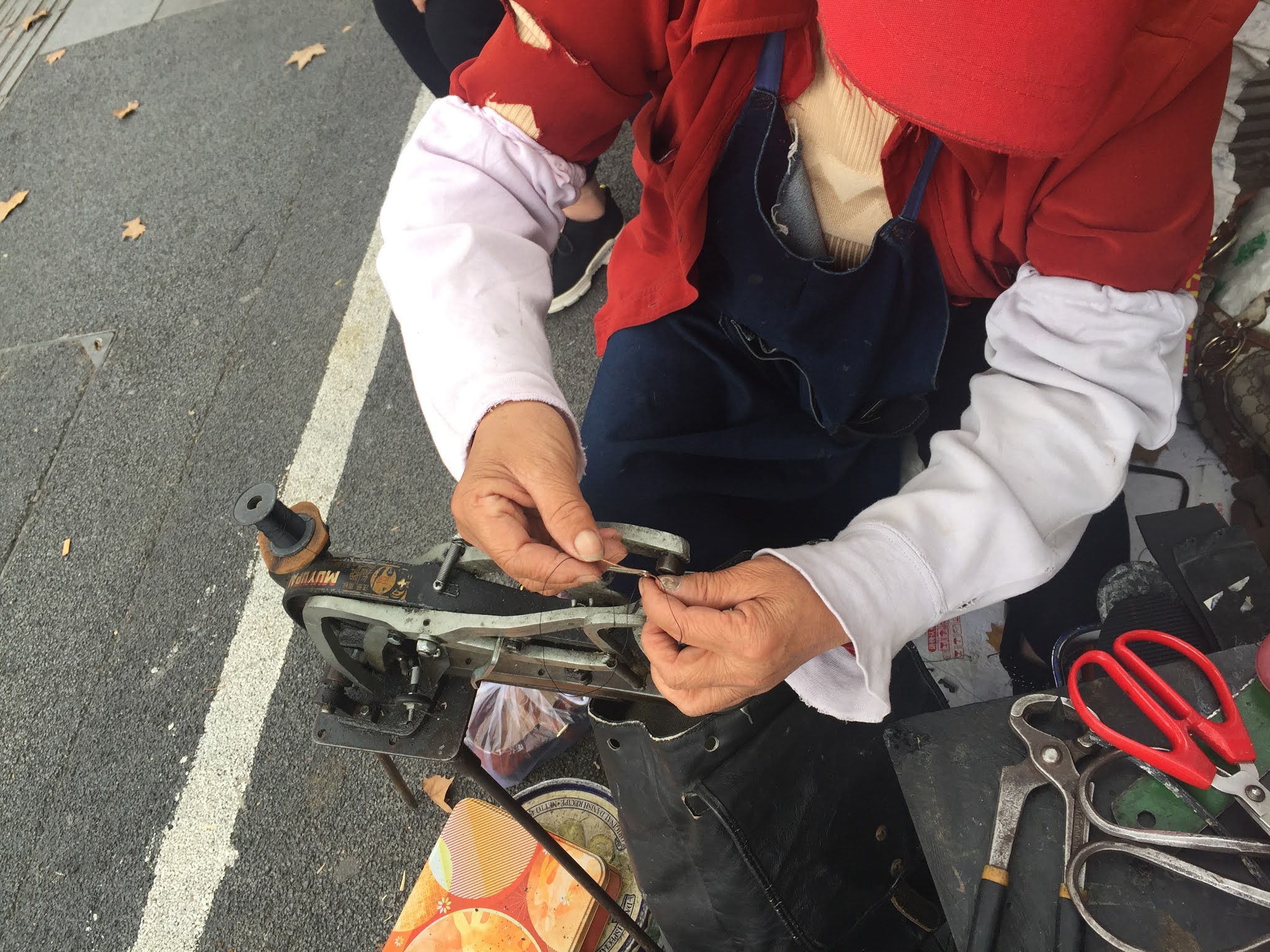
As I set out to bring my backpack back up to snuff, in the process I decided to investigate as well I could this handdriven machine from a local perspective. As it happens, my wife was already familiar with a cobbler who has made her living outside the gate of the campus where her father obtained a position as a professor.
Stitching and threading
I arrived with my backpack in need of some stitching along a failed seam and a list of questions that I imagined would appeal to the many new overseas owner of these popular machines. I recorded a video clip as she restitched for me and further watched as she repaired soles, replaced zipper slides, and restictched damaged handbags until my wife returned from her errand to act as interpreter.
 |
No fancy pinstriping, decal transfer
|
 |
Note: No numbers for year nor month
|
 |
Rethreading again during the seam repair
|
I asked about the different brands and models and why she settled on the MuYuPai brand. She explained that it was her first machine and that it's the only one that she has ever worked with so she cannot compare to others. She began her trade in 1982 when she was 12 years old and has remained at this location since then. I asked about any modifications that she makes to improve performance and what the weaknesses of the designs that she discovered. Her responses emphasized just how foreign my questions were. The machines that she was using was the third and that it was already two years old. She didn't alter the machine from the factory in any way. As for principal weaknesses, she said that eventually there are just too many problems with the machine and then she just buys a new machine from the local dealer the address of which she held a secret. Just because.
 |
After 30+ years of staking out a corner, a painted outline
|
 |
Restitching after adding a new zipper slide
|
 |
Heel repair while a customer awaits in socks
|
Traditional curbside cobbling In the end, I discovered that anybody interested in how to maximize the potential of this low priced device can quite readily learn more from Youtube and other online resources than I could have learnt from a cobbler who has used it during her ongoing career lasting nearly 40 years. I noticed that her stitches were not parallel to the edge and sure enough, there is a Youtuber with a method for adding a stitching guide to a similar machine along with others which highlight how to improve its function.
 |
Manufactured and marketed locally
|
The Chinese name for this is 补鞋机 (Bu3xie2ji1), literally repairing shoes machine. Entering this term on the Taobao
website produces a slew of similarly low priced devices. If you want a place to begin learning more about these machines,
here is a website in Chinese.
It follows that a nation that manufactures so many lady's handbags, luggage, and counterfeit bicast apparel and boots also manufactures the machines to make those handbags. I haven't dived into this recent phenomenon as to why so many crafters are buying these cheap cobbler's machines from the PRC but despite the simple fact often stated by new new owners that they are astoundingly cheaper than vintage machines of superior quality manufacture, I finger Amazon as the main cause for their arrival and proliferation.
 |
A definite upgrade
|
Frankly I think that anybody who wants to do quality leatherwork with a super cheap starter machine gets as much as he pays for regardless of green marketing appeals. Leather is certainly not cheap so why risk working on costly raw materials with such poorly made tools when for a few $100s more, no need for fettling a new purchase, sturdy bases, replacement parts in stock, higher resale value, and with an option to motorize at a later date, higher quality models are available here.
But I digress. Back to the backpack repair:
While shopping in Shanghai for threads, elastic, twill tape, cloths, and other sewing notions (because Nanjing is too small to support such comprehensive markets) I discovered a source of hardware fixtures. The challenge as so often is finding what is needed; the prices on the items are usually negligible.
 |
Pennies to purchase; dollars to find
|
 |
Hardware selection
|
 |
Luxury buttons
|
 |
Fabric market
|
 |
Leather goods workshop
|
And so I had the necessary items on hand already after getting the cobbler to restitch. I had to recover the carrying handle so I stitched tow lengths of overlapped woven tape and then stitched that to the original core. I basted it first but it was still a struggle to machine stitch. I then topstitched together wo lengths of the woven tape to replace the shoulder straps. The replacement brass Chicago bolts were much easier to use than the split rivets I had used to repair the backpack that failed almost immediately after I began using it.
 |
Mega piping
|
 |
Material failure
|
 |
Copper split rivet and washer
|
The lower buckle tab had failed in the same way as the upper one had years ago which I replaced with real leather from a charity shop purchased belt, which still remains functional and looks the same as when I attached it. I decided that instead of replacing with leather as before, since I didn't have tools for punching holes, I would use a length of twill tape and make eyelets with one of my recently purchased threads!
 |
Reattached handle and shoulder straps
|
 |
New drawstring and locks
|
I had tried to buy buttonhole quality spun linen but some items still elude me and this lower pocket receives very little usage and hardly any stress so in the spirit of Kintsugi, I chose a thread that would highlight my hand stitchery. I reviewed the process on YouTube, of course, and was reminded that many eyelets merely rely on a satin stitch, I opted instead for a buttonhole stitch since I wanted the extra loop to help keep the parted twill weave open during and afterwards.
 |
Replacement twill tape
|
 |
eyelet holes
|
 |
buckled and secured
|
I think it turned out okey and able to withstand another decade or more of regular wear.
 |
Rear view
|
 |
Laggard's view
|
 |
Service while you wait
|
Happy All Saints' Day, infidels and true believers! 🙏