|
| 四仰八叉凳 |
A common sight in many rural Chinese
households is this particular stool, known as 四仰八叉凳 or Si Yangbacha Deng, a name that means simply: stool with four splayed legs. Its design is basic : rectangular seat, four legs, with stretchers
between the short lengths. Its distinguishing feature is how the stretchers
(I've seen some versions with double stretchers) keep the legs in place, which I've never seen wedged into the seat mortises, and often
become loose with wear and seasonal changes because they lock the
legs into a triangular configuration. This piece of furniture has potential to
be a beginner project since it teaches layout of mortises, cutting of
tenons, and application of geometry. I've never made one myself nor
have I ever watched the difficult and critical step of inserting the legs into the
seat mortises while simultaneously pressing the stretchers into the leg
mortises.
 |
Triangular lock
|
 |
Common and neglected
|
|
This difficulty was confirmed to me
while I was involved recently with a newly forming woodworking education facility
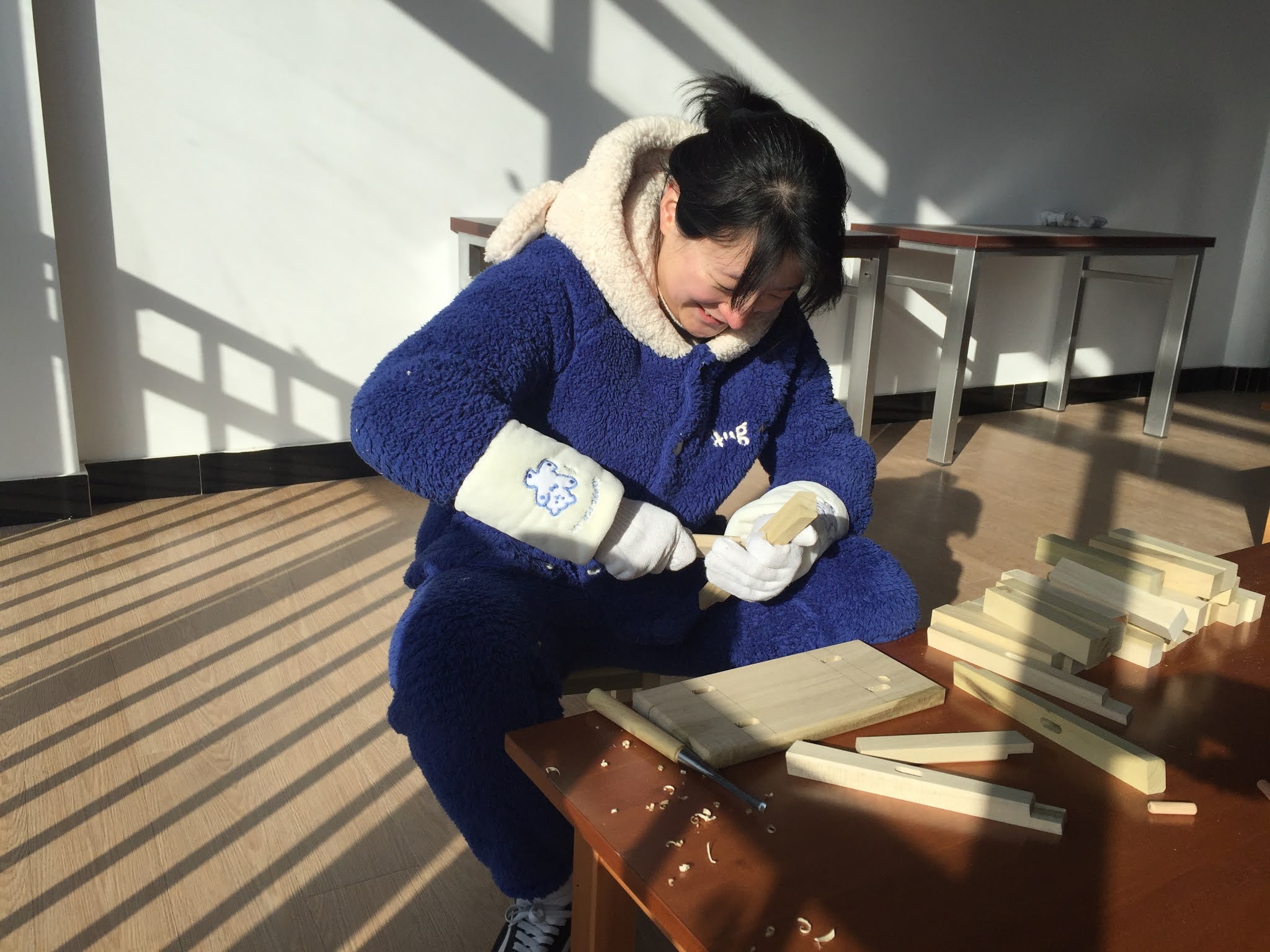
in Huzhou, Zhejiang, named by the founder: The Elephant Commune. The first event occurred on the 9th of January and was a demonstration of mayhem which involved the participants pounding together components
of a 四仰八叉凳 prefabricated
in the adjoining factory without instruction of how to assembly. The
losses were evident with some stools abandoned as the participants
exited. I don't use the word, students, because there was no teaching
occurring. Office workers with no woodworking experience were pulled
in at the last moment as was I to assist in the chaotic experience.  |
Huddling in the cold
|
 |
working in the light of the setting sun
|
 |
a graphic designer lends a hand
|
 |
| it didn't happen if it isn't posted on social media |
|
 |
nothing so fun as fitting legs in holes
|
 |
sorting out the leg arrangement
|
 |
Still struggling with the leg assembly
|
Some participants more wisely chose to assemble the other stool
model, which was easier to assemble but without instructions and not
without its own set of challenges.
 |
Banging and Pounding
|
 |
Production assembly
|
The factory owner had learned of my reputation and work history
through her contacts in Shanghai where the Huzhou operation had been
before the present facilities had been built and relocated about two
years prior. She gave me a rough outline of her personal story: how
she and her husband began as factory workers and (somehow) had become owners of
the factory, how she had once emigrated to Canada but then decided to
return after a year, how she was developing the Elephant Commune in order to allow
her Canadian educated son to replace her in the daily operations of the furniture
exports, and how she wanted me to cooperate with her to teach
woodworking.
 |
| Elephant carved in poplar by Fan Huilin |
 |
and the logo that it inspired
|
I asked for a detailed job description, which
had not occurred to her as necessary for hiring. When I made a visit in
December to her Huzhou factory complex and was given a tour of the
location where she wanted me to teach, I pointed out some of the
salient problems: the decision to locate the teaching and work area
on the third floor without an elevator, the lack of electrical
outlets, the inadequate lighting, the absence of heating or AC. Her
curt response to all my concerns was: 'don't worry'. This should have
been a red flag but I deeply wanted to begin doing woodworking again
and get back into teaching.
 |
Mother finishes her daughter's Luban lock puzzle
|
It required several prompts before I
was given a detailed job description that I had been asking for. I
responded by suggesting that I not be hired as a regular employee but
as a 'craftsman in residence', a variation on 'artist in residence'.
I even put forward the idea that I would be establishing an 'in
residence' program, which if I became a full-time employee eventually,
I would also help with selecting the next in line. Looking back I was
naive to have thought this term would have meant anything to her or
that a factory owner would have bothered to clarify its meaning
before agreeing to my proposal.
 |
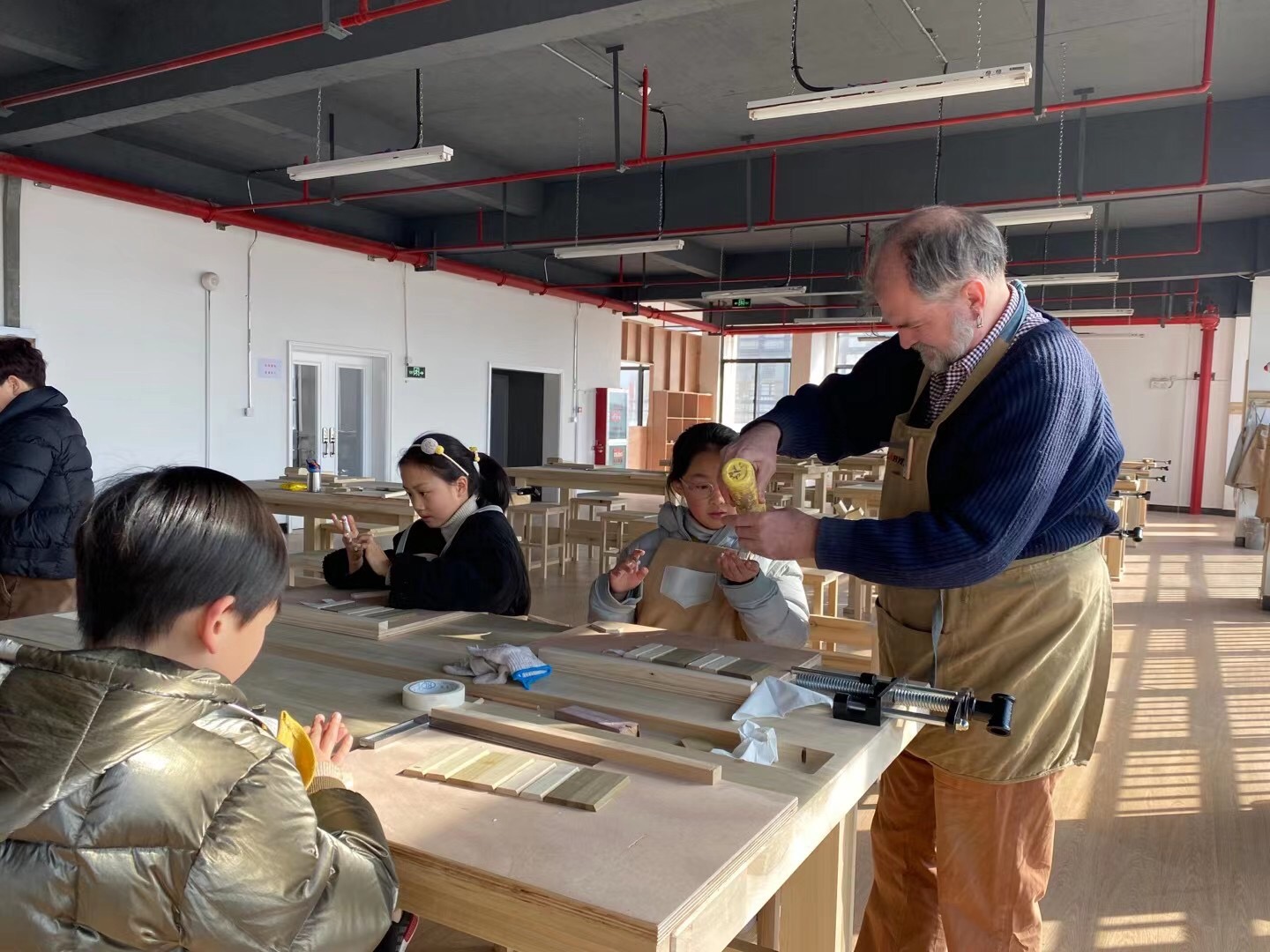
Squeezing glue
|
I arrived on the 4th of January with
a majority of my handtools and teaching materials. The weather was
bitterly cold, making any work in the workspace uncomfortable even if
the cleaning ladies (ayi) had not insisted in opening so many windows
to allow for fresh air to circulate. Because.
 |
On the upside, it was sunny
| | | |
|
The more immediate problem for me,
however, was having no mattress to sleep on.
 |
Minimalism in mattressing
|
 |
The bedding upgrade
|
Prior to the event on the 9th, my first two projects was my
explaining how a French cleat storage system works, determining where
to locate the woodworking machines prior to installation of
electrical outlets, and as a volunteer, pleading with the factory owner to not have closed cabinets along the entire east wall in front of the
windows, limiting access to natural lighting and becoming dead
storage space.
 |
Machines awaiting setup
|
All three tasks were challenges which I
could not have thought so overwhelming. I worked alongside a graphic
designer who was understandably confused about French cleats because
she had never seen one, and because the visual examples that she found on
the mainland intranet were wrong or simply didn't show enough details
to allow her to comprehend the simplicity of it. The factory had, in
fact, already cut and delivered components to the third floor minus
the 45 degree bevels that make the system work. They were even
predrilled for the vertical members that needed to be attached to the
concrete walls. For reasons that only mainland Han might be able to
explain, the horizontal slats were shown in the blueprint to go from above eye level down to floor level.  |
Chinese style French cleat wall
|
I explained
that there was very little advantage to hanging tools on French
cleats below the waist so I advised that an open cabinet be built to
run along the full length of the wall and the French cleats begin
from the cabinet's height and rise upwards. Besides, the fact that
the cabinet ended up without a kickplate, it turned out well.  |
The difficult to conceptualize French cleat wall
|
I won't even go into the details of how
even more frustrating it was to describe picture rail and how it can
obviate the need to drill a new hole into concrete to redecorate a wall. The
experience did, however, clarify in my mind how the Han Chinese think
about concrete construction in general. Not only is it the dominant
construction method, it's equally regarded as much less permanent
than I would consider it.
 |
Last step: Light fixtures and outlets
|
The redundantly unproductive discussions about the
outlet locations and arrangement of the woodworking machines led to
the one and only meeting of interested parties while I was in
Huzhou. It can be puzzling for an outsider to understand why the
electricity is often the last utility to be installed. As I recall
from my stint at Harvey, the woodshop had compressed air piping
installed before the necessary outlets for the machinery. When I was
asked to define the arrangement of the woodworking machines and where
I wanted the outlets (spaced 2 meters apart along the east and west
long walls. I anticipated locating a cantilevered lumber storage unit along the northern
wall and shelves were already in place along the southern.), I
explained that I wanted the machines along the center line of the
room to reduce the lengths of hoses to the dust collector and the
electrical cords to be suspended from the ceiling. I thought I was
clear in explaining the details and the reasons for the choices. But
I explained again. And again to a growing band of befuddled looking
electrical workers. A meeting was called to resolve the undefined impasses. I
demonstrated again the arrangement for the woodworking machines to
the attendees. The leader of the electrical workers (calling them
electricians gives them too much authority) insisted that he could
not recreate the working situation as I had in the Nanjing
International Woodcraft Club in Pukou as he showed me a photo of a
class I conducted there. I cannot fathom why he fixated on this photo
or how it was connected to the present discussion. Finally the leader
of the electrical installation crew, a Mr Bao, who certainly due to
coincidence is the brother of the factory owner, expressed some
details as to why the installation of the outlets was not proceeding.
He started complaining that the machines had different plugs which
require different corresponding outlet fixtures. I would not have
thought that this might have created such a challenging impasse since
most outlets in the PRC allow for different configurations of
electrical plugs but it seems that allowing him to express his
discomfort was enough to allow the project to move forward. In the
end electrical outlets were hung from the centerline of the room for
the machines and far fewer outlets than spaced 2 meters apart along
the long walls. Because.
 |
From Pukou to Huzhou
|
Later during my stint, the factory
owner asked me for suggestions about her addition to the buildout for
installing a doorway that would occlude the natural sunlight from
morning until evening in the only place on the third floor where this
happened and where I wanted to eventually set up my own workbench,
“look very simple natural generous feeling” As diplomatically as
I could, I responded: “It would certainly be a pity to erect
another door in the brightest area of the woodshop” Consideration
of natural lighting was not on her list of priorities. It seems that
the only way to control access from the second floor to the third,
which was only now realized at this late date was to build a wall on the
third floor in the area that was most desirable for working. Because.
 |
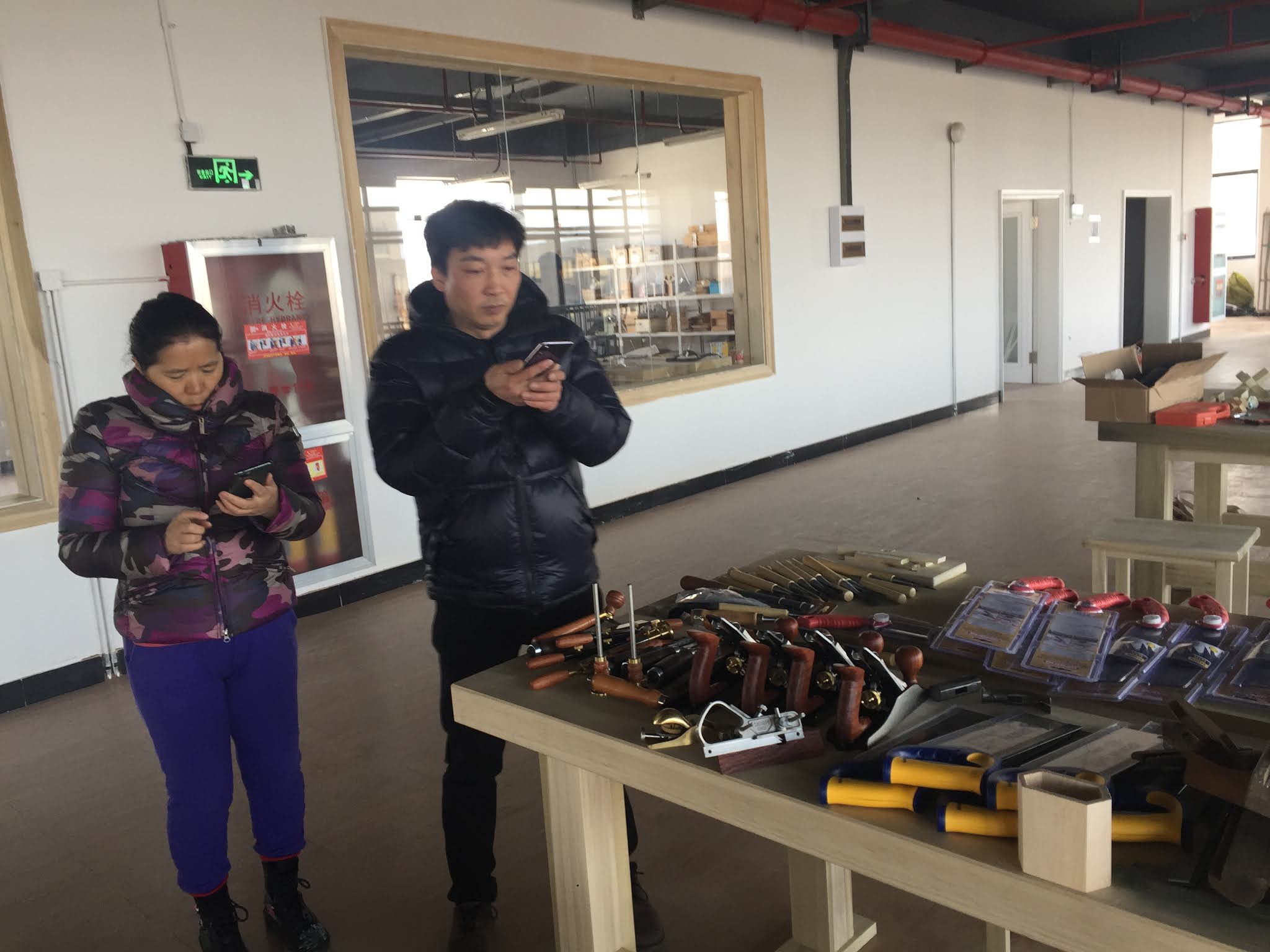
Handtools for wall decorations
|
January 9th was a scheduled
event that involved inviting large numbers of participants to pound
together stool components with claw hammers. The chaos led to the
factory to produce benchhooks based on what I use.
 |
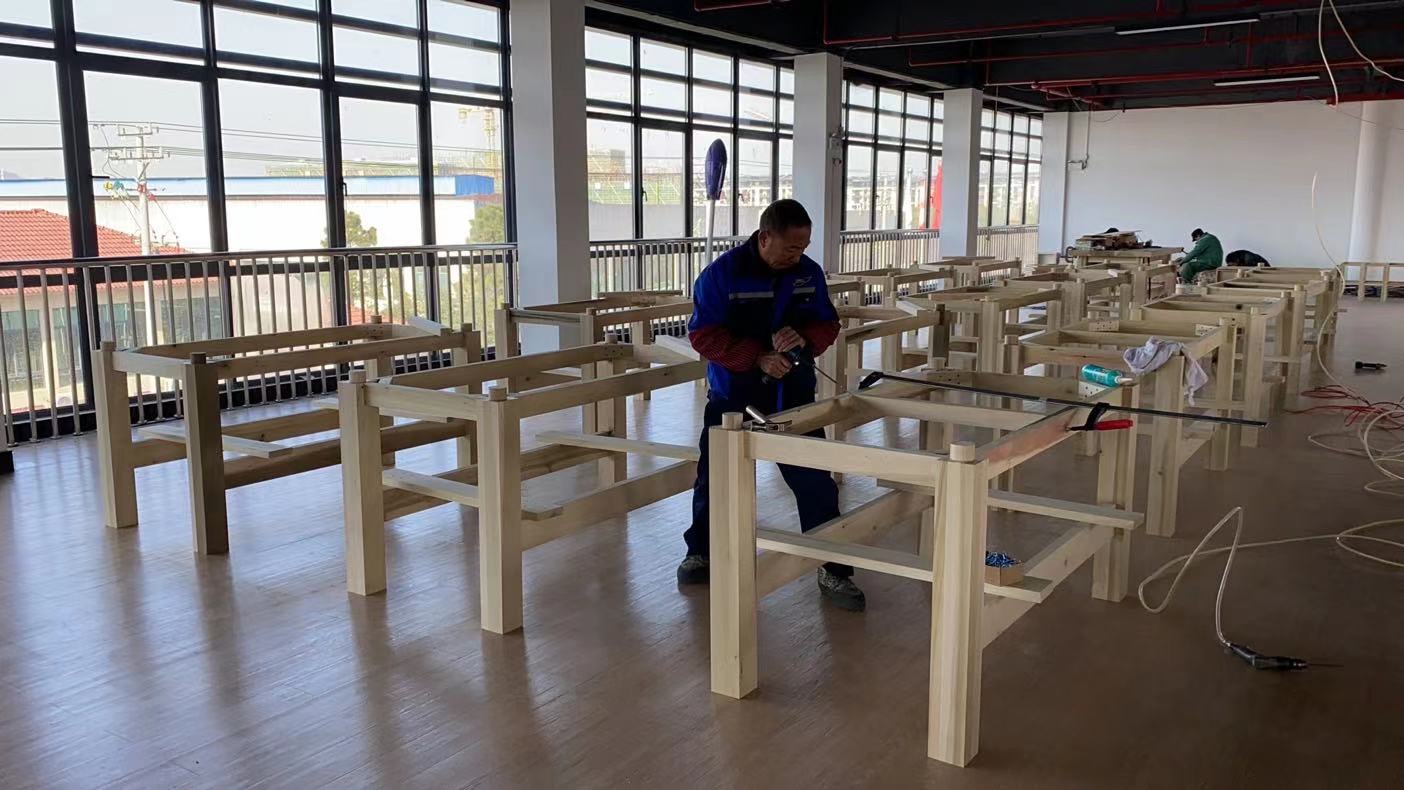
Factory made tables
|
 |
Modeled after a Chinese classroom
|
Well before I arrived in Huzhou, I was
sent a photo of the workbenches that were being assembled on the
third floor. I responded that they were not suitable benches for
woodworking and that it would be better for me to build proper woodworking
benches after I arrived. (This was before I knew about a pressing
event scheduled for the 9th) I received the standard
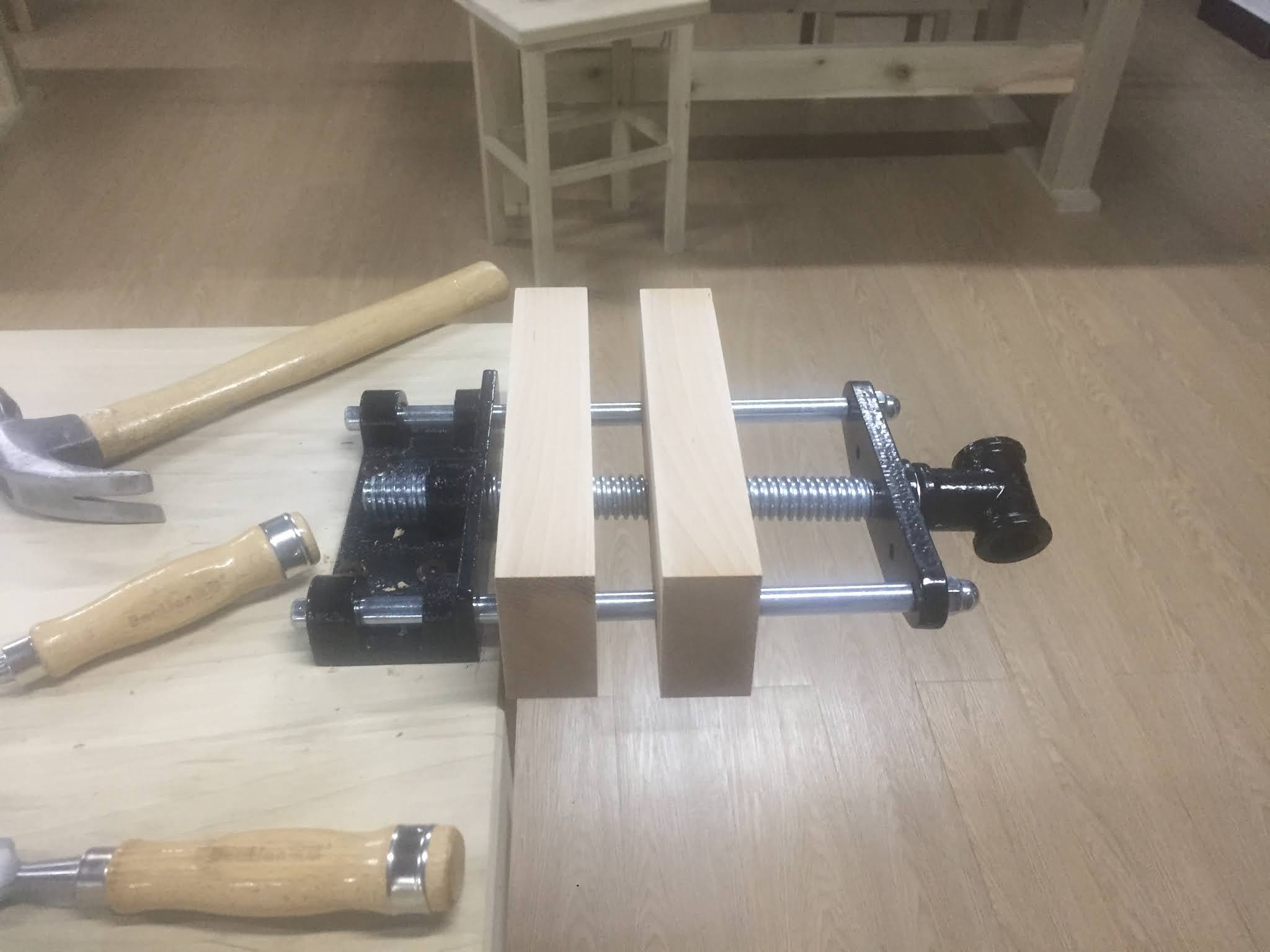
response: “Don't worry” After I arrived, I was asked to install
end vises, I demonstrated that the vises were of low quality and that
Moxon vises could be made from wood with German made taps and dies
(which could subsequently be used to teach a class) and showing very
clearly that the vises would not fit on the benches without damaging
the stretchers and the corner braces. This was the result.  |
For every bench a vise
|
 |
The vise as installed
|
On the 17th a young woman
from Shanghai began her employment in the woodshop. By that time I was
debating whether I could stay in this workplace for a full year
commitment. I was still confident than that I could bear the unrelenting chaos
and clueless approach to woodworking instruction as long as I could remain sanely calm above the
fray, potentially setting examples by osmosis, as with the adoption of bench hooks, until
either the end of my craftsman in residency tenure or until I thought the organization was ready for me as a long term employee. I eventually
learned her name and shortly afterwards I discovered that she actually
had some experience as a woodworker.
 |
The upgraded vise installation
|
 |
a bench appliance unfriendly to saws
|
Briefly, she attended a Shanghai trade school as a senior middle school student, participating in a training program that existed in order to compete in WorldSkills, a Dutch based organization that hosts trade skills competitions worldwide. She was young with little experience that wasn't learned in
an industrial training program but she and I had much more in
common.  |
Little wood horse kit: just add super glue!
|
She even readily understood that it was a bad idea to allow
small children to use cyanoacrylate adhesive (i.e. super glue) to complete
projects. And to her credit, she helped me to wipe away the clouds
that I needed to leave this place, albeit briefly.
She began to take on her assigned role
of intermediary between me and the factory owner according to the
norms of a mainland work environment wherein orders are typically
conveyed indirectly from top to bottom, probably, to prevent any
feedback from moving, in response, from bottom back up to the top.
 |
Real! Wood
|
 |
the straw that broke
|
I was shown a photo of a
四仰八叉凳
and informed that I needed to make an example by hand,
which would then be given to the factory so that components could be
manufactured in bulk. I countered with a series of reason why this
was not my responsibility and that I would not be making such an
item. I explained that I was not an industrial designer and nowhere
in my job description was I required to make production prototypes. I
pointed out that there were already two stool projects. I patiently explained the that
most expeditious means of obtaining a prototype would be to buy one
online (quite possibly the same one in the photo) and give it to the factory.
There might be some backstory to this workplace demand or it might be an example of the boss reaffirming who the boss was. More than likely, it was yet another impulsive whim on her part. It's apparent that this is just another example of 仰八叉凳 but with round members. I've hinted at the chaos of the event on the 9th but I need to explain more. It became apparent that the best method for assembling the stool components had not been thought through.
 |
Broken seats from the first event
|
One can say that the solution to this problem was creative but it's really just an example of making a square peg fit into a hole in a less breakable seat. Negative outcomes entirely predictable when there is no planning and so a solution was found that might negate the need for further planning or curriculum design.
 |
Melamine sandwich
|
 |
Factory ordered components
|
These plywood components were ordered from the factory to produce as a quick fix to the problems which arose due to lack of preparations and poor understanding of how to design woodworking courses. It was a factory owner's solution to a production problem, upgrade the stock material to make the problem simply go away. And no, I didn't see one of these melamine seat stool assembled to be able to confirm whether the solution was workable.
 |
Using a chisel to complete a project
|
Rather than accepting the need for a comprehensive lesson plan with a project that could be reasonably managed by a participant with no experience, I was assigned another task from the one I was there to accomplish. The intermediary explained that this
requirement fell under my responsibility for creating courseware and it was not a
template for the factory. Yes, she asserted an argument which
contradicted what she had just told me. She further explained to me
that this assignment fell to me because I had not developed
any courses that met the two hour timeframe. I did my best to suppress my fury mainly because she was simply conveying a directive. I explained
that in addition to the rope spinning, which I had demonstrated on the 9th,
I had proposed three projects that could be turned into courses that
accommodated the two hour timeframe. This back and forth was getting
nowhere essentially because that was the main point.  |
World Skills instructor
|
My wife had just received a copy
of my labor contract which she was planning to take back to Nanjing in order to
have it looked over by an HR professional. The message that I was
being told to accept, and which would have been implicit to most other
Chinese workers in this same situation, is that a job description could be reinterpreted in
anyway imaginable by the factory owner to suit her spontaneous whims.
If making a factory prototype can be interpreted as courseware
design, then any assigned task can similarly be imposed on me under
the same open ended interpretation. Further evidence that I was there to be
nothing more than a common factory assemblyline worker, I had just been informed on the previous day
by this same intermediary that my new work schedule would be
08:00-20:00 6 days a week with Tuesdays off, nercifully. With two hours
subtracted for lunch and dinner provided by the factory canteen, this
amounted to 60 hours a week. Evidently the concept of craftsman in
residence had been ignored.
I asked my wife whether the work
schedule was specified in the labor contract along with the salary
(or was it calculated hourly?). She explained that work schedule and
hours required to work fell under the 'rules of the factory' clause.
A labor contract only needed to specify theoretical compensation.
Have I mentioned that common practice of docking wages in the PRC?
 |
Subzero woodcraft
|
I lay in bed that evening and came to
the conclusion that I needed to accept that my position there was not
in line with why I was willing to relocate and was, therefore,
not tenable. I determined that it was simply better to resign immediately while
my wife, Julia, was still there to help me negotiate a withdrawal. In the morning, I sent a message via the wechat app
to the factory owner with the reasons for my resignation. She asked
for a meeting at 09:00 during which she explained that she was a very
important person who owned five companies before excusing herself to
speak with a banker. Remaining at the conference table were Julia, me, and
the intermediary. We didn't know how soon we would be able to
continue so Julia and she chatted lightly and eventually I brought
the topic back to why I was leaving so at the very least one person
would understand my reasons.
 |
No elevator
|
The intermediary before the factory owner returned, unprompted asked me the question: "What can you bring us?" I didn't understand where the question was coming from or how to answer it. I naively responded: "all my woodworking tools" Afterwards, my wife explained that this is a standard interview question as well as the question, "What is your advantage?", which I knew from another context. The young intermediary was possibly parroting what she thought she should say, unaware that this was an exit interview and her boss had not passed my interview process.
 |
Discussing rope spinners with Chen Yonggang
|
I had been dreading the inevitable
task, which I could postpone mentally, of packing up and returning to
Nanjing with a truckload of my belongings. The reshipping was suddenly
upon me. The logistics of moving back were complicated by a staff of workers who were less enthusiastic about moving my things onto the truck than they had been upon my arrival. They seemed afraid of getting on their boss' bad side since she had not yet given them orders to help move out. The biggest struggle was getting the workbench down to the first floor and then onto the truck. I was prepared to disassemble (it was designed to be unbolted after all) but as the last item, it was eventually carried back down the stairwell by a band of sturdy men who had been given their orders. |
What can you bring us?
|
Chun tian kuaile!