Showing posts with label milk paint. Show all posts

07 January 2024

Last class at the Yangpu Bilingual High School

woodworking tables and chairs

         On January 4th I conducted the final woodworking class of senior middle school students at the YangPu Bilingual school. The school officially refers to this course as Design and Technology but I wasn't made aware of this distinction until I was given the student roster. 

The guardhouse of the closed campus

         
             I came into this job through Chen Yonggang who has learned to supply contract teaching to school administrators who understand that there is a need to provide their students with handicraft instruction but lack the institutional skills to do so internally. He provides the materials, the teachers, and the projects that the students complete. He mainly hires young women to teach students in primary schools. I agreed to teach the high school aged students since I knew that their English level would have allowed me to actually instruct. Somehow accepting this job compelled me to also teach a class at the primary school level. My reasons for why I didn't think this was a good idea were irrelevant since Chen Yonggang had already promised to the school that he could provide with a foreign teacher.

 
Multitasking

            As it happened, the school informed me while I was travelling in Hungary that they were not pleased with my classroom management with the primary school students and upset that my class and the one being taught simultaneously in the adjacent classroom were not synchronized. So I guess in the end, my reasons won out. This worked out for the best since I was teaching the primary school students four days a week for . As a result I only needed to commute once a week to Shanghai.

The primary school class schedule


            This seemed to have been the first time that Mr Chen has been contracted for a course at such an upper level and with a western instructor. He decided in advance that the students would make model of a Dougong timberframed structure. He even hired an extra man to develop the prototype that would then be copied by the students. I entered the classroom with this in the back of my mind and stressed to Mr Chen that I needed the model as quickly as possible to help motivate the students onto their main task.   


         To his credit, Mr Chen observed the first class that I taught during which I introduced the themes of timberframing, the research and life of the architect, Liang Sicheng, the tools associated with the trade, and the recent rebuilding of Notre Dame. I conduct this style of lesson in order to gauge the students' level of English. It was evident that there was a wide range of abilities. 

Critical part for the turningsaw project

        Mr Chen confessed to my wife that he was there in the classroom with me on the first day so as to be able to offer me some tips to help me out in the classroom; he, instead, confided in her that he was impressed by the amount of information that I was able to present in an organized manner and how well the students remained focused.  Yeah, it's called teaching.  

Dougong model
            The bulk of the coursework were projects that Mr Chen has developed for his own courses and for sales. One of the projects, for example, was the same folding stool that I have already written about. Other projects included both a bowsaw and a turningsaw, a try square, and chopsticks. In this classroom, the students are given metal vises to hold wood. I donated a few bench hooks from my own failed woodworking school and a few students recognized their utility but there weren't enough. With this in mind and the upcoming dougong model, I decided on teaching the students how to make the Underhill style bench hook. 
Still from Lie Nielsen film studios
        The construction of this bench hook offered the students an opportunity practice layout, crosscutting with their newly made bowsaws, and paring chisel techniques. I thought it was a great addition but Mr Chen wasn't convinced until I showed him the video. And then he was very concerned that I would be teaching the students how to use a chisel. He is as much concerned with the possibility that a student might cut himself as how parents would react when they learned that their investments were being put at risk.

Painter's palette


 contact milkpaint fumes


            I conducted a lesson on making milkpaint on the Thursday before Christmas. There was less enthusiasm for this lesson than I had gotten in the past. There was however a lot of enthusiasm for painting which many students were very talented in. I don't think any of the students understood that the plywood forms represented spherical tree ornaments. Most students treated the precut pattern pieces as a flat board upon which they painted Christmas scenes.

Abandoned decoration

Common photo pose


On the last day, I repeated the instructions as to how the interviews would be conducted and I put a list of names on the whiteboard to help facilitate the sequence. I sat in an adjoining room and waited nearly 15 minutes before I reentered the classroom to remind the class about the interviews. 

Adrian completed the bench hook!

Peter, volunteer bodyguard

Eric and his two saws

Vanessa and her projects

            I got a final opportunity to learn the students' names and get feedback about the course and projects. While I did manage to routinely interact with all the students during the previous months of Thursdays, I wasn't always able to speak with them in a meaningful manner. In the interviews, some students were clearly imitating what they had just learned from their exiting classmates what to expect, having quickly memorized and rattled off answers to questions I had not yet asked. In other instances, the students revealed just how little working vocabulary they acquired: "wood make this."

Steven

Katerina

Chet!

Yuki


I finished this last lesson late and discovered that the teaching assistant had already moved onto her next class period. I sent a pic via the social media app, WeChat, to her and she thanked me. Class was over.  

Hammers and saws

painted tool arrangement

As I was leaving the building, I poked my head into the adjacent classroom where an art lesson was being conducted. I saw that the woodworking tools had been repurposed for another teacher's painting class.

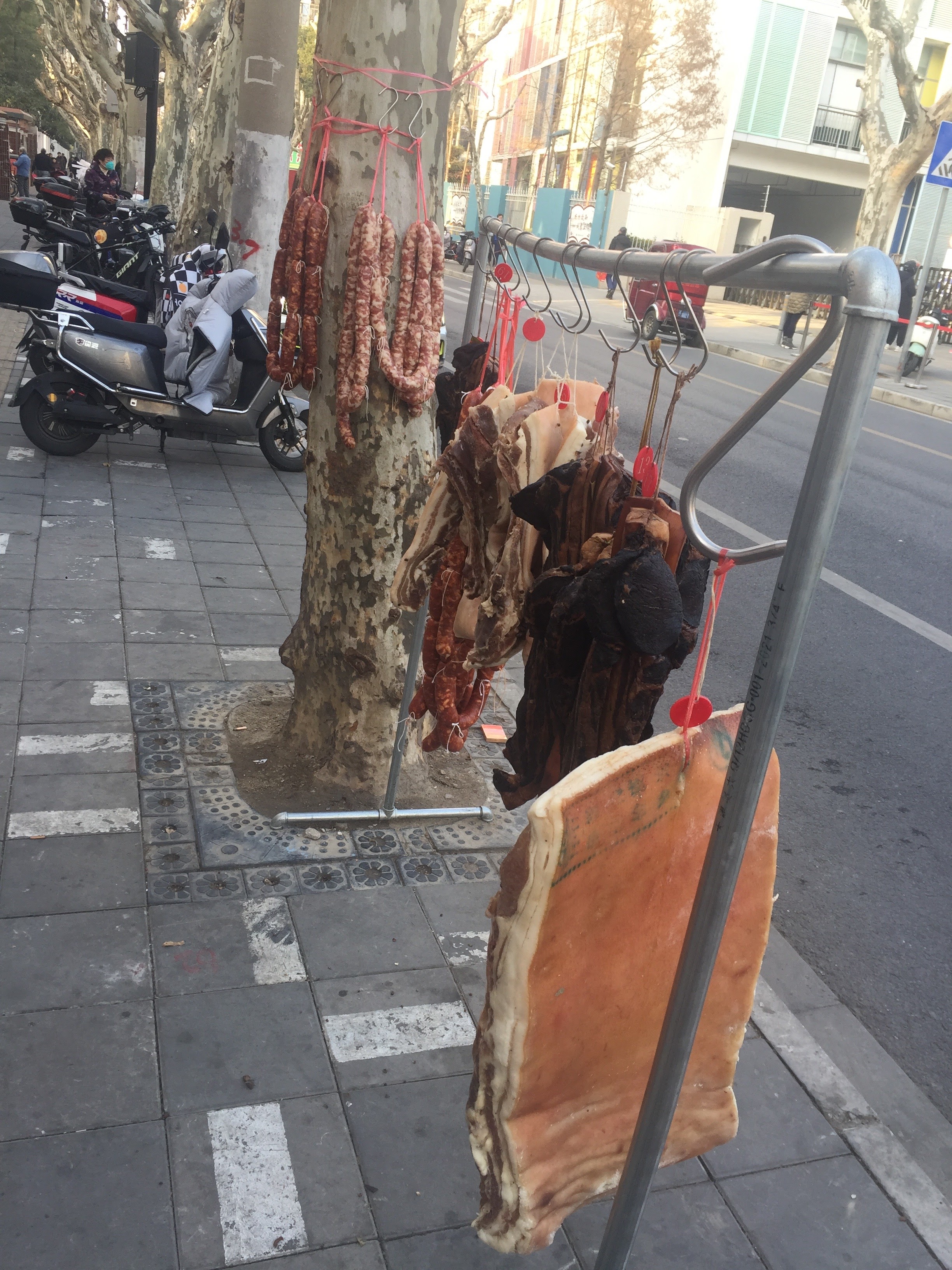
Geese and sausage

Bacon and sycamore


The preserved meats one can see streetside in a major metropolis   

To all those who celebrate, Happy Epiphany!


21 December 2017

A bookcase of necessities

In the raw
Frequently it behooves a woodworker to build something that will stand as convincing evidence to settle impromptu disputes with regards to the amount of money spent on tools, books, and other necessities of life. It followed, therefore, that I needed to build a bookcase to house my ever growing book collection, which can stand in the livingroom to create a more peaceful home environment. I bought Schwarz's The Anarchist Design Book primarily for his information on seating furniture, but as it happens, I followed and completed the plans for the boarded bookshelf first.
I don't know whether I reached the conclusion from experience or from one of Schwarz weblog postings that he wrote during the writing and research on the book, but I knew that I preferred fixed shelving. I won't bother with my own reasoning since the Kentuckian lays out his case fairly well. I'll go through some of what I have learned in making this piece of basic carcase construction and point out my own variations and the one place where I think Schwarz's design can be significantly improved.

The first point that requires attention is that this is a large piece, larger than most projects for those who primarily use handltools. It requires a correspondingly large assembly area and adequate tools to the task, which I learned conclusively that I didn't have. Because of the nature of globalism, I was only able to buy a single 48" parallel clamp and 3 at 36" from a Taiwanese distributor. At least, I thought I bought the 36" clamps, but the maximum capacity as I learned from making this piece is 31", which is what I had to cut my final width down to, removing 5" from the 3 shelves.
15" of excess beech banded shelving
But it's easier than trying to cut boards longer after discovering a snag in the middle of construction. Only because there was somebody else in the woodshop making tabletops from imported beech, did I have a handful of strips which I then glued to the edges of the shelves with the expectation that this will reduce problems with abrasion and denting. This detail is not intended to be equated with the dropped edge that Schwarz mentions. That construction method limits the height capacity of the shelves with little structural benefit in my opinion. I chose nominal dimension pine lumber for this piece because that is what I readily can obtain. This required glueup to make the 13" sides that Schwarz recommends. After resawing to approximate thickness, adding the beech strips was just another part of the process of sizing the major stock pieces.

Clamping up the three shelves into their corresponding dadoes is an acrobatic challenge even if all the pieces are uncupped and perfectly fitted. Trying to apply warm hide glue beforehand only adds to the complexity. I found that I could partially assemble the shelves and then allow some hide glue to trickle into the joints before tightening the clamps. Because I was working in an unheated workspace, I squirted some hot water into the joints to help the glue flow down the full length. The main function of the glue at this stage is to hold together the assembly until the nails are driven in.

Gluing the kickplate to the main ssembly
Schwarz made his bookcase in a minimalist, modernist style, eschewing ornamentation, except beaded backboards, and moldings. This makes construction fast and easy, yet it also allows for individualist flourishes to express themselves. I decided that the bottom kickplate merited some attention. It helps to provide rigidity to the bottom shelf and squareness to the carcase. If I make this piece again, I will trim it just above the floor level. As it is. I assembled the kickplate proud, gluing it in the dadoes and to the lowest shelf, planing it flush afterwards.
Playing card shims
the historically accurate back

Rabbeted top rail back discreetly receiving the backboards
There is one element of the boarded bookshelf design that I suggest be altered to improve the function and simplify the construction. I think that this detail also follows more closely to the handicraft tradition. After resawing construction lumber to dimension the 3/4" stock, I was left with stock that I used for the shiplapped, beaded backboards. There was severe cupping in this waste stock, which I split before surface jointing. The backboards are effectively random widths, ripped to create stock without voids nor problem knots. The thinner stock was rabbeted with a tablesaw on the backsides and the thicker stock was rabbeted and beaded  on both edges with an upgraded Veritas plowplane and beading blade to the frontside. These pieces also received dadoes to receive the shelves, lending support and stiffness to the frame. I chose to make a top rail with a rabbet along the back for two reasons. It hides the back completely from view. More importantly, it saves effort and material when attaching the backboards, allowing the use of odd lengths that don't require a flush edge along the top since it is tucked underneath the top rail. I also made the top rail cap the ends, covering any potential gap in a clear line of sight. This type of top rail also gets inserted into a rabbet in the sides rather than a dado, which immensely simplifies the joinery. Even in perfectly clear stock, cutting out a rabbet is easier than chopping out a groove.
The knot around which the bookcase was constructed
A dimension of the top rail is specified as 4" wide. This also happens to be the same width of the kickplate so the number was likely chosen to keep the parts list easy to remember. While the kickplate's is determined by the height of the lowest shelf, the top rail's width isn't so constrained. The wider the top rail can allow for using shorter length of backboards; if the top rail is too wide, however, the beaded back details will appear out of place. I chose to allow a defect of the stock to determine the width. I chose to stop the rabbet on the sides that receive the top rail just above a knot to avoid the difficulty of paring close. I let the tree determine the final appearance.
a painterly effect
I always intended to paint this piece. Pine and other softwoods lend themselves to painting despite recent trends and modern aesthetics. The idea to paint the stripes on the highlight the dado joints came to me as a means for obscuring the nail heads. Milkpaint doesn't adhere to metal surfaces reliably well. I use Tremont nails, which are effective fasteners but not decorative. And with the paint in hand, the muse, Moulariprionia, casually whispered to me: "it will be ever so lovely to paint a false leg detail along the side bottoms." And she's correct with her guidance as usual. I chose iron oxide black to hide the nails because I had the pigment in stock, but in retrospect, I think the Umber/Sienna pigment would be more appropriate. The trompe l'oeil lightens the mass of the piece.   

Completed and awaiting a librarian's touch as soon as the BLO has dried


11 October 2017

First Woodshop Openhouse

I managed to organize a free public event at the woodshop during the National Day holiday. I had tried to coordinate this with the woodshop chief but this proved to be fruitless. I simply plunged ahead and let the woodchips fall.  WeChat (weixin) is the default mainland China chat application and it is equally used for both commercial and personal communication. Since I don't have a national ID, I cannot take full advantage of its business options so I must post on my photostream and then some Chinese supporter can manually repost.
The initial inquiry
This was the first posting to mention the event. It didn't generate much response, except for a couple who teach at university. I set a date based on their availability. And they did come and expressed an interest in classes at the end of November so I can claim a modicum of success.
The invitation
When I was ready to advertise the time of the event I posted this, which generated much more eager enthusiasm for reposting. Nobody appreciated my reference to Tom Sawyer with a 'free' painting party and nobody dared to ask about this reference. And even before the event, I heard the apologists perfunctorily suggest excuses for the low turnout. Unprompted they consoled me: "National holiday. Lots of people go out for traveling." and "The timing is not good. All the Chinese travel outside for the festival." Because what I mostly need to know is when I might be doing anything wrong, not a better option. And naturally it is imagined that potential students are freer to visit during their regular workweek. The concept of RSVP, as I have just learned, is not part of Chinese culture. As it happened, most visitors were my wife's colleagues with whom she gained some face as a result of her reposting and the majority of them arrived without announcing their intentions.
A professor picks up a brush

Iron Red, Iron Yellow, Chromium (III) oxide
Students on task
Two Moravian stools (ein Schemel) and a computer desk organizer
The three young men attending with their mother,  a former colleague of my wife, seemed eager to learn about woodcraft, the smallest in particular. They're at an age, however, junior middle school students, when it's unthinkable that they devote any but all their time and mental energies to preparing for the gaokao examination. They were fun to have around and provided a satisfying counterbalance to the younger 'little emperors' who showed up,  and who demanded more attention from the grownups.

explaining how to use a paintbrush

A family who does woodcraft together...

the importance of keeping the paint properly stirred

focused on task

a mother learns a lesson

I did the preparations for the milk paint in the apartment owned by the woodshop chief. It's still mostly unfinished and so I used the sink in the bathroom. I would have taken photos but it seems weird to take photos in such a place, especially since it was so crowded. I carried the prepared curds back to the underground
Obligatory group photo

In the end, stools were painted; word was spread; goodwill was shared; and connections were established.
Inspired by the works of Samuel Clemens
As gratifying as whitewashing Aunt Polly's fence, I reckon

Then for a moment my back was turned