Showing posts with label timberframing. Show all posts

07 January 2024

Last class at the Yangpu Bilingual High School

woodworking tables and chairs

         On January 4th I conducted the final woodworking class of senior middle school students at the YangPu Bilingual school. The school officially refers to this course as Design and Technology but I wasn't made aware of this distinction until I was given the student roster. 

The guardhouse of the closed campus

         
             I came into this job through Chen Yonggang who has learned to supply contract teaching to school administrators who understand that there is a need to provide their students with handicraft instruction but lack the institutional skills to do so internally. He provides the materials, the teachers, and the projects that the students complete. He mainly hires young women to teach students in primary schools. I agreed to teach the high school aged students since I knew that their English level would have allowed me to actually instruct. Somehow accepting this job compelled me to also teach a class at the primary school level. My reasons for why I didn't think this was a good idea were irrelevant since Chen Yonggang had already promised to the school that he could provide with a foreign teacher.

 
Multitasking

            As it happened, the school informed me while I was travelling in Hungary that they were not pleased with my classroom management with the primary school students and upset that my class and the one being taught simultaneously in the adjacent classroom were not synchronized. So I guess in the end, my reasons won out. This worked out for the best since I was teaching the primary school students four days a week for . As a result I only needed to commute once a week to Shanghai.

The primary school class schedule


            This seemed to have been the first time that Mr Chen has been contracted for a course at such an upper level and with a western instructor. He decided in advance that the students would make model of a Dougong timberframed structure. He even hired an extra man to develop the prototype that would then be copied by the students. I entered the classroom with this in the back of my mind and stressed to Mr Chen that I needed the model as quickly as possible to help motivate the students onto their main task.   


         To his credit, Mr Chen observed the first class that I taught during which I introduced the themes of timberframing, the research and life of the architect, Liang Sicheng, the tools associated with the trade, and the recent rebuilding of Notre Dame. I conduct this style of lesson in order to gauge the students' level of English. It was evident that there was a wide range of abilities. 

Critical part for the turningsaw project

        Mr Chen confessed to my wife that he was there in the classroom with me on the first day so as to be able to offer me some tips to help me out in the classroom; he, instead, confided in her that he was impressed by the amount of information that I was able to present in an organized manner and how well the students remained focused.  Yeah, it's called teaching.  

Dougong model
            The bulk of the coursework were projects that Mr Chen has developed for his own courses and for sales. One of the projects, for example, was the same folding stool that I have already written about. Other projects included both a bowsaw and a turningsaw, a try square, and chopsticks. In this classroom, the students are given metal vises to hold wood. I donated a few bench hooks from my own failed woodworking school and a few students recognized their utility but there weren't enough. With this in mind and the upcoming dougong model, I decided on teaching the students how to make the Underhill style bench hook. 
Still from Lie Nielsen film studios
        The construction of this bench hook offered the students an opportunity practice layout, crosscutting with their newly made bowsaws, and paring chisel techniques. I thought it was a great addition but Mr Chen wasn't convinced until I showed him the video. And then he was very concerned that I would be teaching the students how to use a chisel. He is as much concerned with the possibility that a student might cut himself as how parents would react when they learned that their investments were being put at risk.

Painter's palette


 contact milkpaint fumes


            I conducted a lesson on making milkpaint on the Thursday before Christmas. There was less enthusiasm for this lesson than I had gotten in the past. There was however a lot of enthusiasm for painting which many students were very talented in. I don't think any of the students understood that the plywood forms represented spherical tree ornaments. Most students treated the precut pattern pieces as a flat board upon which they painted Christmas scenes.

Abandoned decoration

Common photo pose


On the last day, I repeated the instructions as to how the interviews would be conducted and I put a list of names on the whiteboard to help facilitate the sequence. I sat in an adjoining room and waited nearly 15 minutes before I reentered the classroom to remind the class about the interviews. 

Adrian completed the bench hook!

Peter, volunteer bodyguard

Eric and his two saws

Vanessa and her projects

            I got a final opportunity to learn the students' names and get feedback about the course and projects. While I did manage to routinely interact with all the students during the previous months of Thursdays, I wasn't always able to speak with them in a meaningful manner. In the interviews, some students were clearly imitating what they had just learned from their exiting classmates what to expect, having quickly memorized and rattled off answers to questions I had not yet asked. In other instances, the students revealed just how little working vocabulary they acquired: "wood make this."

Steven

Katerina

Chet!

Yuki


I finished this last lesson late and discovered that the teaching assistant had already moved onto her next class period. I sent a pic via the social media app, WeChat, to her and she thanked me. Class was over.  

Hammers and saws

painted tool arrangement

As I was leaving the building, I poked my head into the adjacent classroom where an art lesson was being conducted. I saw that the woodworking tools had been repurposed for another teacher's painting class.

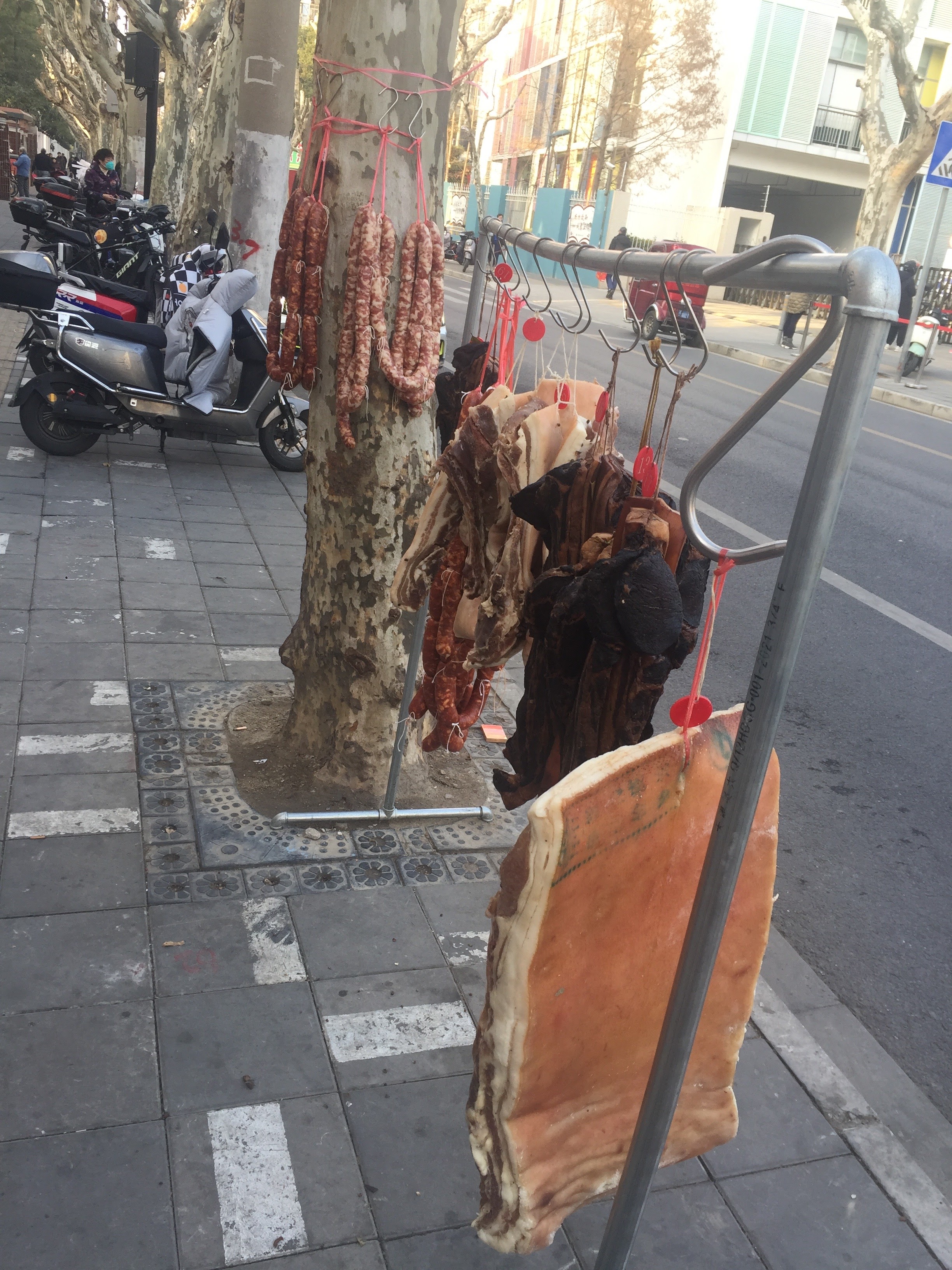
Geese and sausage

Bacon and sycamore


The preserved meats one can see streetside in a major metropolis   

To all those who celebrate, Happy Epiphany!


11 July 2019

Nara Palace Museum Reconstruction Project and the Takenaka Carpentry Tools Museum

So Kawaii
Of the many impressions and memories from my recent venture to Japan, two destinations merit mentioning and praise. The first and the one that I discovered only by happenstance once I was in Nara.
Reconstructed Imperial Gatehouse
The city of Nara is a well established tourist destination notable for its temples, gardens, and roaming herds of selfietolerant deer. Initially I wanted to avoid interacting with the deer, being far more interested in the landscape gardens and the many mini museums, especially a restored machiya. 
Traditional house interior

Steep stairway
erstwhile modern kitchen

Understair drawers

I might not have considered trekking the distance from our downtownish B&B to the Palace site if I had not been alerted to the scale and importance of the UNESCO world heritage site by a energetic pair of globetrotting Canadian ladies.

My firsthand experience with the Nara Palace Historical Park is that it is long term project that is comparable to the ambitions embarked upon by the Colonial Williamsburg Foundation, multiphase project to reinterpret the past in terms of material culture and traditional skills. The area that is referred to as the Heijo Palace Site is so large that a railway line cuts across it. A museum is located at the main entrance helps visitors understand what they are about to see while wandering over the still mostly empty landscape.
Map of the historic landscape

Local fauna


Interactive Joinery display

Construction model

Archaeological recreation


 One of the Canadian ladies who has also written on her weblog about their travels through Japan and Nara shared with me the photos that she took on the previous day.
Spear planing

Foundation and covered construction site

workman with adze

Costumed timberframers
 
Movable workspace covering
I wasn't able to view the ongoing traditional construction under its purpose built superstructure but I did have a very engaging conversation with a docent at the assembly hall, who was very well informed and surprisingly honest about the potential shortcomings in interpreting the multitude of details of the reconstruction. I wanted to chat longer but there were other buildings that I wanted to visit before the park closed for the day.

Completed Audience hall


Audience Hall interior

Interior plinth

Audience Hall closeup
Throne nook
The park features reconstructed secondary buildings and perimeter walls along with preserved portions of the archaeological excavations left in situ and built upon along with museum commentary.
Historic plinths and elevated foundations

Reconstructed rammed earth perimeter wall and gateway

Reconstructed secondary buildings

Ridgebeam and rafters

Eave detail of reconstructed secondary buildings
It's an education in archaeology and historical recreation. This is a location that I intend to return to again, fully prepared, and eager to see the progress of reconstruction and what programs have been developed to interpret this historic site.
 
Whichever direction leads to the destination
 Takenaka gateway
The Takenaka Museum of Carpentry Tools was only my list of places where I decidedly wanted to visit. As it happens, the most expedient manner of getting to there is by the Shinkansen. Experiencing just how well integrated this high speed railway was with the rest of the landscape further emphasized just how compact living is in Japan. From the exit gate of the railway it's simply a two block by foot walk to the Takenaka Museum.
Campers on the bank of the Nunobiki stream passing under the Shiinkansen viaduct at the Kobe station
The museum is mostly underground, the first floor is for reception and, on the day of our visit, an exhibition room featuring turned items and those of woven bamboo. Photography was forbidden.
Adult class in progress
The second  basement is where the classroom is located. I saw several examples of projects geared at children's classes, yet notably I watched an adult class being instructed on weaving a small basket.
Junior level projects
There was a teahouse with details on its construction, which is its own specialty trade.
Reproduction teahouse wall section
 There were several interactive exhibits and a recreation of a smithy.
Bellows and forge

Files and scrapers

Imported tools, too!
 What caught my wife's eye was a reproduced carpentry booklet with construction notes from the 19th century. She pointed out to me that nothing similar exists in Chinese.
Timberframing tools

Layout and marking tools
No nails in Japanese carpentry. Never

And of course lots of tools.
Joinery sample

Riving timber with gluts
Sawyering

And how tools get used and a few interactive displays.
Dougong compenents

Dougong roof display

I was only disappointed by the lack of an English version of their museum book.

Mugged in Nara by Sika
 Happy Summer!