Showing posts with label consumerism. Show all posts

06 July 2026

Refurbishng two 19th Century Chests of Drawers


The handmade chest as it appeared on FB marketplace

The refurbished curb find     
       I've finally completed saving two antique pieces of furniture to add to my house in Huntington. The first item was a handmade chest that I bought through FM marketplace. A bit impulsively but I am more than pleased with how it turned out and my having rescued it from further decay.

    The second chest, a factorymade item, was picked up curbside shortly after acquiring the former.  I hadn't yet gotten a functional woodshop in order but they could serve first as motivational projects while assessing the collective damage and developing repair strategies.

    The factorymade model was manufactured with ceramic casters. Three of the wheels were intact but even that's not good enough. I purchased replacements in brass. I ought to have bought the models with the thickers stems but I made the undersized models fit snugly by using electrician's tape to bulk it out.


Properly supported andlestick holders and drop pulls on a handmade chest

     I pondered how to repair the broken candlestick holder.   These are often attached to mirrors as a means of reflecting the light back out into the living space.In better quality construction, the support is bracketed.  The candlestick supports on this model were secured with a singular woodscrew, one of which remained attached; whereas, the second had failed. Initially I imagined that I could fabricate a bracket that would be joined to the support pad with a sliding dovetail.
The meretricious candlestick shelf

The compromised improvement 

Underbuilt and underscrewed


        I wasn't until I had obtained a piece of locally milled walnut (along with tulip poplar planks for other repairs) that I realized that such an upgrade would not work. The uprights were beaded and A bracker would cover them. At best the bracket would only provide stability and I didn't want to drill through the uprights in order to better secure the candlestick supports with an additional woodscrew. This meant that even with the brackets jointed into the bottoms of the pads, they would only be held in place with a single woodscrew. It dawned on me that these were simply decorative items that were not functional today any more than in the past. I determined to remove the remaining support before it was also broken.

    Even though the handmade chest had its own distinct challenges and quirks, one problem straddled both items and many other similarly constructed chests of drawers.  The drawersides present two intertwined weaknesses. The narrow bottoms must bear the full weight of the drawer's contents as it is withdrawn and reinserted into the chest. This repeated action causes the drawerside to be worn down over time ad well as the runners. 

    A second inherent weakness of such a groove that is plouhged into the sides in order to receive the drawerbottom. This necessary groove renders a weak component even weaker and is the source of many drawer failures. Solutions to this are slips and tapered sides. Slips do appear on high end furniture yet I have only ever heard of the Shakers using this technique, likely due to its slightly greater labor investment.    


the restored drawerside

    My solution to counter the wear on the factory chest was to square up the bottoms of the drawersides and then to attach shims in order to repair the loss. I used beech in this case because they were handy but even a dense pine would suffice. 

Screwed down in slot

 
Drawerback thickener
    The Knapp joint cutting fixture likely was also used to join the drawer back into the sides.  The pins were were cut out of a drawer back of the same thickness which was then driven into a line of holes drilled into the drawer sides.


damage cased by loose drop pulls

The replacement pulls and closeup of the faux veneer

    The vanity dresser was originally produced with drop pulls. Even though this piece was set to the curb, stuffed with a bag of various hardware fittings and components from other furniture items, the correct drawer handles were absent. I tried finding modern drop pulls with backings large enough to cover the circular scoring caused by the originals into the drawer fronts. It turns out that elaborate drop pulls have fallen out of fashion during the previous 100 years. And there isn't a very active secondhand market. I settled on a different style, obtained from a hardware supplier located here in Indiana. The walnut adequately covers the damaged fronts and blends in with the vintage design.


Escutcheon inlay

Patched

Drawbored joinery and drawer stop

    The handmade chest is a piece rich in history. It's the only signed piece that I have obtained and it is extremely confusing to interpret what occurred during its construction.  The piece exhibits the qualities of what, I believe, would have indicated a high status piece. I've not been able to identify the primary show wood, but it is extremely dense which is in contrast with the escutcheon inlays.The split turnings and uprights suggest perhaps and workshop with specialized tradesmen or a diversely skilled individual cabinetmaker. The drawer fronts exhibit London style dovetails. 


It doesn't show so the mistake didn't count

Chopped and unfilled 
        And yet the piece is notable for the errors of its original construction. The damaging repairs across the years will get itemized separately. The most obvious mistake is the groove that runs around the inside top of the largest drawer. Evidently the layout lines were mismarked and the components were too valuable to dispose of and begin anew. Peter Follansbee has documented many examples of this with handmade objects. It's the case that the amount of labor already sunk into the the boards compelled the workman to make due. He and the customer were willing to overlook such flaws. Similarly there is a unused mortise in the front uprights due to mistaken layout. The stretcher just above the split turnings enters the uprights with a double mortise. The upper stretcher, by contrast, is oriented so that it only enters the upright with one tenn. The ghost mortises remain empty.

Original nail, suitably placed, clinched onto short bottom board

    The drawer bottoms merit their own highlight reel. The goal must have been to construct them out of one flatsawn pine plank. I have seen examples of bottoms that have shrunk over many years of use. A gap either emerges at the front of the drawer because the bottom is fixed to the drawer back or a gap opens up at the back as the wood fibers age and sometimes cup.


Original shim on bottom board, nonetheless too small

Hammer blow marks and a later repair

    The drawer bottoms, too narrow to serve their only function, left the workshop with gaps. I lost some of the photos of this project when my mobile was stolen at my workplace, but there are enough details to show that the oldest style of nails were used to pathetically patch these gaps. Roughly chopped shims were crammed behind the pine bottom, leaving slits. It boggles the mind to understand such shoddy work, albeit hidden, could commingle with the classically proportioned and decorated front


The workman's signature on a drawerside

    I initially planned on fully replacing the bottoms with new tulip poplar. In the end, I instead decided to incorporate as much of the original pine as I could with a width of new tulip poplar glued onto the reworked bottoms. All this would be for nothing, however, if I could not come to terms with the damage done to the drawer sides     

earlier repairs


Nail holes from a century of bodging

    After injecting some hot water into the dovetail joints, both front and back, the drawer sides components could be easily disassembled with light blows. I would be using hide glue to reattach these joints and PVA glue to widen the drawer bottoms.

gap at the drawerfront due to shrinkage 

    I selected the densest and straightest stock of southern yellow pine to serve as shims for the rebuilt drawer sides. I left the stock slightly fat, a nod to tapered sides, but also to allow for some variation with the old wood. I glued the new stock onto the old, flush with the outsides.

Ripping off the bottom of the drawersides on the new bandsaw

     
cracked groove in a drawerside

    I was able to rip off the bottoms of the drawer sides with the kerf passing between dovetails. I then jointed the edges. Because I would have to groove the sides with a handplane, I left the stock longer. This procedure would be better accomplished with a tablesaw.  I should have taken better measurements since I struggled to layout the grooves onto the newly rebuilt sides. The third ones were the easiest and produced the best fit.


Reassembled drawer with London style dovetails

   
a broken pin cleverly glued into its corresponding socket

     
I transferred the marks from the dovetails onto the sides and sawed. One was too tight and cause a split, which I invisibly glued and clamped. I applied hide glue to the dryfit joints and assembled, checked for squareness, and let sit without clamps.


New drawer bottom in use

     Regluing the new shims of tulip poplar onto the old pine bottom was only slightly tricky. Each glueup required three of the long bar clamps. Out of the clamps, they were handplaned where the inside surfaces weren't aligned.  I planed down the underside bevel so that it matched up with the original contour, using a strip of wood with the same groove groove and with the sides to test for snugness. Since these are flatsawn, some cupping was evident which made assembly rather difficult. I chose to plane down some that cupping to make the newly widened bottom slide more easily into the grooves. Additionally I planed the front of the bottom panel,  squaring down the steep bevel with a skewed rabbet plane so that the would fit readily into the groove of the drawer front. I would thus secure the bottom with hide glue alone. The thickness of the bottom didn't require any fastener at the back.


wood butchery


wane in back of top and a clipped corner

    This chest suffered abuse throughout its existence. Not only the botched repairs with nails driven willy nilly in the manner of an annoying uncle, but at some time, the top was sawn along the right side and at the back left corner.  I can only surmise that at one time this chest was crammed into a closet space which required the butchered modifications

detail of back corner and distinctive chamferring of dovetails on the drawerbacks 


    Happy 250th anniversary to the constitution! It feels invigorating to be back in the woodshop and diverting Americana away from the landfill 


31 July 2023

Shanghai consular visit and classroom observations

Ostensibly the latest jaunt into Shanghai was focussed on submitting my wife's paperwork at the Hungarian consulate in order to obtain a Schengen zone visa for our trip scheduled in October. The whole process proceeded more smoothly than the wife was expecting despite my reassuring her that she was exactly the kind of Chinese tourist that was welcome into Europe. 

As usual we try to fill our our time while in Shanghai with new experiences unavailable in Nanjing. Mr. Chen Yonggang has been helping me find employment ever since we were both pushed out of Harvey Industries. I arranged with him to observe the courses that he had been teaching in order to see whether I could fill in as an English speaking instructor.

With Master Chen Yonggang in the SATA facility
The first observation was of a class in the Sata training and instruction center. The best way that I describe this event is as a team building activity for the sales staff during a training weekend. It was a bit chaotic. Mr Chen had reduced the actual amount of woodworking to a minimum, having fabricated all the wooden parts on a newly acquired CNC machine and the webbing from an contract supplier.

Proctoring the camp stool classroom
The salesmen simply had to round over the tenon corners in order that they be insertable into the round mortises. That and assemble components correctly in order to make a folding stool.  This style of stool, 马扎凳, Mazahdeng, horse tie stool, calls to mind a Han Chinese horse saddle.

Weaving a seat

Rounding a tenon with a rasp


I didn't get any instruction as to how the stool was best assembled so that I like most of the other attendees just learned from experience as we progressed.


SATA sales training event
On a positive note, perhaps due to the dearth of clear instruction, there was ample amounts of cooperation and mutual support. I struggle to understand why a participant would bother to assemble a project and then abandon it before moving onto the next agenda item on the training schedule but as a result my wife got a free 马扎凳 to bring home.


Mr Chen explains the latest project
The second event, which I witnessed and to which I lent a greater hand, involved considerably more woodworking instruction with students who were there as eager participants in learning their craft. Possibly purposefully, I am kept unawares about the details of this ongoing course. The wife and I tracked down the CCP funded community center where the class was held on the third floor. This was a multipurpose building with a small courtyard for sports activities while nextdoor a film was being screened and a lower floor contained a lending library. 
A bowsaw, a miter square, and their owner/maker
When I observed some of the tools the students had in their possession, I recalled the prototypes from previous visits to Mr Chen's main workspace. He initiated the lesson by giving those who were ready to move onto the next step in the curriculum a length of pine which had a rabbet cut along its length. The plan was to cut four lengths with ends at 45 degrees, using the student made tools before somehow gluing them together in order to make a pictureframe.

Most of the students struggled with laying out the miters, using the miniature squares, and then with sawing to the pencil line with a bowsaw, especially one far too short for the task. The only holding device was a metal vise which clamped to the thick tabletops with a bit of struggle.

Seated woodworking in progress
The class was composed of mostly local housewives who evidently were getting their first exposure to handicraft instruction. The circumstances were far from ideal for instruction but the level of enthusiasm confirms that there is an as yet unrealized supply for this demand. 

The light-vented bulbul is a fairly common bird in many Asian urban landscapes and surprising friendly.

Liberté, égalité, fraternité aux oiseaux


Bonne fête natiionale à tous!


03 March 2021

Designism, part 2 *updated 11-03

Mystery item
 I present to visitors of this weblog a mystery item in various configurations that appeared first to me on a wechat stream and a modicum of time to ponder its purpose while scrolling down.

position number 2

It's evident that it is posable and yet it's really unclear whether posability is a useful feature and how it affects utility

Maximized openness

One can readily presume that it's made of plywood due to its structure but does that make it a wooden object or along with the mechanism, simply wood adjacent? 


For those who've not simply guessed what it is, here it is with a pretty model to convince you

So comfy cushions aside

 warning: pinching hazard

Position number 2.5

Back support optional

Dos à dos

that it's a chair. No, really. Typically images that get reposted on wechat aren't linked with the original source, which in part explains why I see so many examples of designism there. The motive for reposting is simply the 'wow' factor in search of thumbs-up and heart icons. I downloaded these images to do an internet search in order to relieve my curiosity as to how the positioning mechanism worked that prevented this piece of furniture from accidentally becoming a human egg slicer. 

Having found the original source, I searched the website and learned that the human egg slicer was properly called the Exocet Chair (patent pending) and offered for purchase in, at least, 5 different veneers, one of which is Mozambique. There is no mention of the number of positions it can be 'locked' into but it is being offered as a limited edition, presumably still in any color, but nothing about the number that Exocet Chairs is limited to.  So is it like an exclusive club which anybody may join until it's full?

Fortunately for me a website that promotes designers (more than 140,000 of them!) interviewed the Exocet Chair's designer, Stéphane Leathead, the leader of Designarium, (yes, that's really the name but with an inverted A). I would not call designer.org (directly to their webmaster's face) a puff generator, but some of the interviewer's questions are: 

    "What kind of emotions do you feel when you design?

        and 

    How do you feed your creativity? 

        and

    When do you feel the most creative?"Sin

Since a few postings ago, I've had more time to ponder the admittedly nebulous notion of designism and I have thus come up with a list of 4 features to formally distinguish this aesthetic trend. It can easily be seen how these categories overlap to some degree in definition and in root causes.

1) Emphasis on novelty:

This is the 'wow' factor that seems to be what generates virality on social media. The rise of digitized image sharing via social media is certainly a factor of the greater spread of designism, but I would argue that it predates the internet with its appearance in many magazines, e.g. Architectural Digest. (Who also remembers sunken bathtubs?) A trend that has likely magnified the growing appearance of designism is the lengthening of manufacturing supply chains, or rather the concentration of manufacturing farther away from urban and academic environments where designers live and work, and the steady dropping of woodworking and other handskills from the general school curriculum and, in particular,  from the curriculum of designers most of whom conceive their patentable consumer goods exclusively with software programs on computer screens

2) Plastic and Industrial aesthetics:

Plastics in so many ways have improved human existence (while their excess use has led to environmental degradation on a planetary scale but honest recycling is only 20 years away) and have allowed for manufacturing processes that would not have otherwise been possible. With this in mind, plastics are often used to fool consumers with the illusion that an item is made from solid wood, or of true veneers. And even as consumers might balk at wood grained vinyl siding or similarly deceitful formica, they have come to internalize the aesthetics of plastic manufacturing that industrialists profit from and highlight as key to maintaining their position in the marketplace: predictable uniformity, overall smoothness, and presumptive disposability. There is also a priority given to patenting a design and creating a copyrightable brand since the 'free' market tends to reward IP more than skills or trades

3) Impracticality

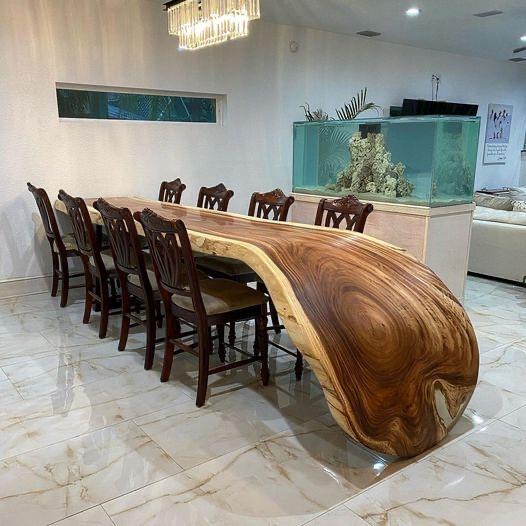
Here is one aspect that might be readily conflated with conspicuous consumption, but in the case of designism, that of a durable good. The first example that I ever became aware of was when as a young boy I was invited into a house that had white shag carpeting that nobody was allowed to walk lest the carpeting get dirty or matted. So, in fact,  the roots of designism precede the internet. I see often with items that are oversized for the 'wow factor' and then occupy more floorspace than similarly functioning items. It has also become common in the art world. Other examples are the 'live edge' that cannot be used as a bearing surface or is needlessly hard to clean. I refer again to the chairs in Ikea, which I have highlighted previously, with their remanufactured rough sawn surfaces, which leads me to the last distinguishing aspect of designism

4) Appeal to artificial rusticity and authentic seeming handicraft

Designism certainly is not the first example of industry's attempts to mass produce items with the appearance of handmade goods. To some degree this is a function which we want industry to serve, to produce more items at lower prices so that more individuals can enjoy them. This is all well and good until the average consumer is so far removed from real handicrafts that industry can strategically fool consumers with more deceitful plastics and in examples that I have already referred to as Real! wood. The epitome of this is the recent trend of "river tables", liters of two part epoxy resin rendered rustic with some offcuts that get encased in even more plastic.  The fact that these tables are promoted as DIY projects conflates handicraft with relocating the plasticized manufacturing process to a home garage

At least most of this table can serve as a flat surface


Just wow, man
 In other more personal news, I did a demonstration of making milk paint in Shanghai to Chen Yonggang, whom I have mentioned working with before, and his partner in a joint venture, a designer who tells me she is inspired by Middle Eastern furniture, in a woodshop the owner of which is a Taiwanese national who studied woodworking in Japan for a decade.  As a couple, he and his wife, teach both in their woodshop and take their curriculum directly to some Shanghai schools that appreciate what they can offer their students.

Shanghai woodworking 木忘初心

Sulfur red pigment


There was some suggestions that I might be able to work with them, reestablishing my operation in Shnaghai with their cooperation but then they are also in the process of looking for a new location to operate from. I can only wait and hope for now.

Terrazzo incorporating recycled glass

Shanghai architectural legacy 建国东路打浦桥街道


Happy Lantern Festival! 

Modernist rusticity

Update: Many customers need just a little more proof that a table is really made from a tree substance: Real! Wood. I found this one on facebook where among the many praises for the table was one suggestion that the hollow is perfect for kids to climb through. Because children have been denied for too long the opportunity to climb under more conventionally made tables.  I spent some time, trying to find the original source of the image or the maker, but page after page of pinterest compilations came up first interspersed with weblogs highlighting the table as a new, bold design for a modern kitchen.