04 June 2017

The Sincerest Form of Flattery: T. Deer tools

"When I think of woodworking, I think of T. Deer...
 I've been working for several months to outfit a new student instructional workshop and have been dogged by many predictable and some which defy definition hurdles; I've also come across a few noteworthy discoveries. In a few cases, I've gone to the trouble, often unforeseeable in its complexity, to order from abroad. It's quite possible that I've bought the last of the 48" Jorgensen parallel clamps from a Taiwanese supplier. It seems just a short time ago that Pony was shipping crates of free clamps to HarveyWorks in anticipation of raking in millions in the burgeoning mainland Chinese market.
I buy domestically both because it can potentially save money and delivery time, but mainly I want to establish sources for replacements and to be able to explain to budding novices how they can readily equip themselves.  It's a constant challenge to find reliable sources for tools and materials. I've had to ship back Stanley tape measures twice because a supplier, although he displayed the model number for metal cases, instead shipped me the tape measures with plastic cases. I had to pay for return shipping. In the second attempt, another supplier sold me plastic cased models again by telling me that they had the weight of model with a metal case which I have in my possession. When I opened the second parcel and discovered  that same plastic junk which I had just previously shipped back, I checked the weight to discover that he had lied to me, overstating the weight by double. He then tried to convince my wife that he had in fact sent us better quality tape measures than ones I had wanted. All this trouble for an item that less than a year ago was a stock item at a B&Q.  Enough already about my problems.
I was directed to investigate a Chinese supplier of holdfasts by Mr. Chen, a colleague during a brief overlap at Harvey. He's now working at a new woodshop venture that is struggling to gain success by attempting to copy what other woodshop training centers do. He had purchased holdfasts to equip his shop and based on this endorsement, I looked into the source. I had purchased as many as I could manage from LieNielsen and Gramercy. I knew that I needed to supplement these.
One theme that comes up again and again is that Chinese manufacturers copy finished products without much consideration for process and a vague understanding of the eventual use. On top of that the workforce is generally poorly trained since or due to the fact that the employees often jump from one company to the next, as indifferent to the source of their income as they are to the tasks that they are assigned as they strive to climb up the economic ladder. For example, not far from my apartment I photographed this front bumper of a minivan manufactured by Wuling Motors. From the CNC mold department, to the assembly line workers, as well as the willfully indifferent midlevel managers who oversee the QC engineers, the organization collectively chose to overlook that their brand name was misspelled as it was being mounted onto every vehicle that left the factory.
If you can read this,...
I mention this here because it almost appears that T.Deer is at least trying to appear that it is developing a brand. For similarly manufactured items, typically none are marked with any signs of origins, certainly not with a brand name. In part, because that requires a modicum effort, and because there is such little sustained interest in China with developing brand loyalty. Contrarily, Chinese consumers can be even more brand conscious than Western consumers, which further beggars belief as to why Chinese manufacturers ignore this domestic market at their own peril over the long term. (hint: much of it has to do with export subsidies, limited market access to international competition,  and shortsighted business planning.)
The clear appearance of high end packaging.
Oh wait, does this shipping parcel look familiar? And yet, simply because a Chinese business is considerate of branding does not lead to the conclusion that the actions are effective or original. For example, I bought these vise parts out of curiosity only realizing later on that it was a shanzhai copy of this new item, a HiVise from Benchcrafted. This is how it was packaged.

Multicolored Styrfoam
The finest drywall screws


There are far fewer of the hardware pieces than what makes up the Benchcrafted original. It comes with no printed instructions. But Benchcrafted already supplies lots of video and printable materials so by not reproducing such incidentals like an instruction manual,T. Deer can reduce its costs and pass the savings onto the consumer! This project is getting put on the back burner indefinitely.
Stripped down to the barest ripoff

The holdfasts show a significant improvement, perhaps because they are harder to make badly.
The holdfasts and battens
On the top and bottom are the T.Deer holdfasts, their large and small models.  LieNielsen and Gramercy lie between. The large T.Deer is functional but some of its shortcomings are evident. The profile stands higher than that of the others. This is tolerable but not as annoying as the sooty schmutz from manufacturing that is not cleaned off before shipping.  The small form (I've not yet used this one nor any other small holdfast) seems to have its pad bent at an angle to cause only the front edge to make contact with a workpiece, potentially rendering it nonfunctional.
T.Deer

Gramercy holdfast pad


Speaking of pads, the T.Deer models come up short here. too. The Gramercy meets certain quality control standards that one can expect from a manufacturer who knows what customers want and how to keep them. The pad has a minimally smooth finish so as to not mar a wood surface and is cleansed of the forging residue. The image of the T. Deer model, left and above, speaks for itself although the photos in their Taobao store show much better looking examples of workmanship. It might also be a due to problems with my camera.
Despite these readily identifiable flaws, I cannot dissuade myself from suggesting this holdfast model to my Chinese students and I will purchase more in the future and potentially suffer the consequences if standards slip down lower. There is no way that I can turn down the price for a simple piece of bent iron. A pair of these holdfasts sell on the Chinese market for less than $10 US (50 RMB). Yes, two of them! With a moderate delivery fee, I can receive them in two or three days. I'll still treasure and prefer my LieNielsen model, but as we expats say: zhe shi zhongguo.
The benchdogs prove to be even more problematic. I bought a pair from LeeValley on which T.Deer likely based their copies. The shortcomings can be demonstrated thus.
The holdfasts and benchdogs come with a new 19 mm spade bit for drilling holes into a benchtop to accommodate them. For all I know, these are, in fact, 3/4" spade bits originally made for export and simply stamped for just the Chinese consumer. 3/4" is equivalent to 19.05mm, which is a reasonable substitute.
Veritas quality snugness

Lesson #1: Cha bu duo = close enough


A problem, however, is that the bar stock that is used to make the holdfasts is 18mm. This leaves a significant amount of sloppiness that can only be overcome by the spring clip. For comparison the Veritas model is measured at 18.84 mm. The fit is smoother and it will also not distort the inside diameter of the benchdog hole over time.
Surface treatments

The quality goes in before the name goes on


The bearing surface of of the T. Deer benchdog exhibits none of the refinements of the Veritas model.
The surface is polished exactly where polishing is not wanted and it does not have the sloped cut to direct lateral pressure into downward force on the workpiece. Lastly there is scant concern for centering the logo on top.
I won't be buying any more of these items and can hardly recommend them to students. Instead I'll be teaching how to make their own in class.
Shopmade benchdog

I can aspire that this essay explains a bit more about the challenges of woodworking in China. And for those readers who think that these items could never be encountered outside the domestic Chinese market, it behooves to think again.


22 March 2017

The last of the Nanjing turners

The turner's atelier
During an outing to visit the whereabouts of a relocated open air antiques market, I happened to find a turner's shop along an older stretch of Shengzhou lu. The turner himself hardly stirred as I approached his workshop and snapped a few photos of the interior.
The view from the workman's perspective on the streetscape
He is a turner in the classic sense that he only does lathework. The narrow shop had a ladder in the back that gives access to an upper level where he might maintain his household. The arrangement struck me as medieval, which in the conservative environment of mainland China, is not unusual, but this way of life is nearing an inexorable finality. I thought of this essay as I gawked about, seemingly like a time traveler. None of the tooling was commercially made. Some of the lathe chisels shows signs of having been made from recycled files. This spartanness is as much due to the paucity of Chinese manufacturing as much as the extreme conservatism of Chinese tradesmen, less pride of craft, apparently than stubbornness and group conformity.
Handmade lathe chisels


The lathe machinery


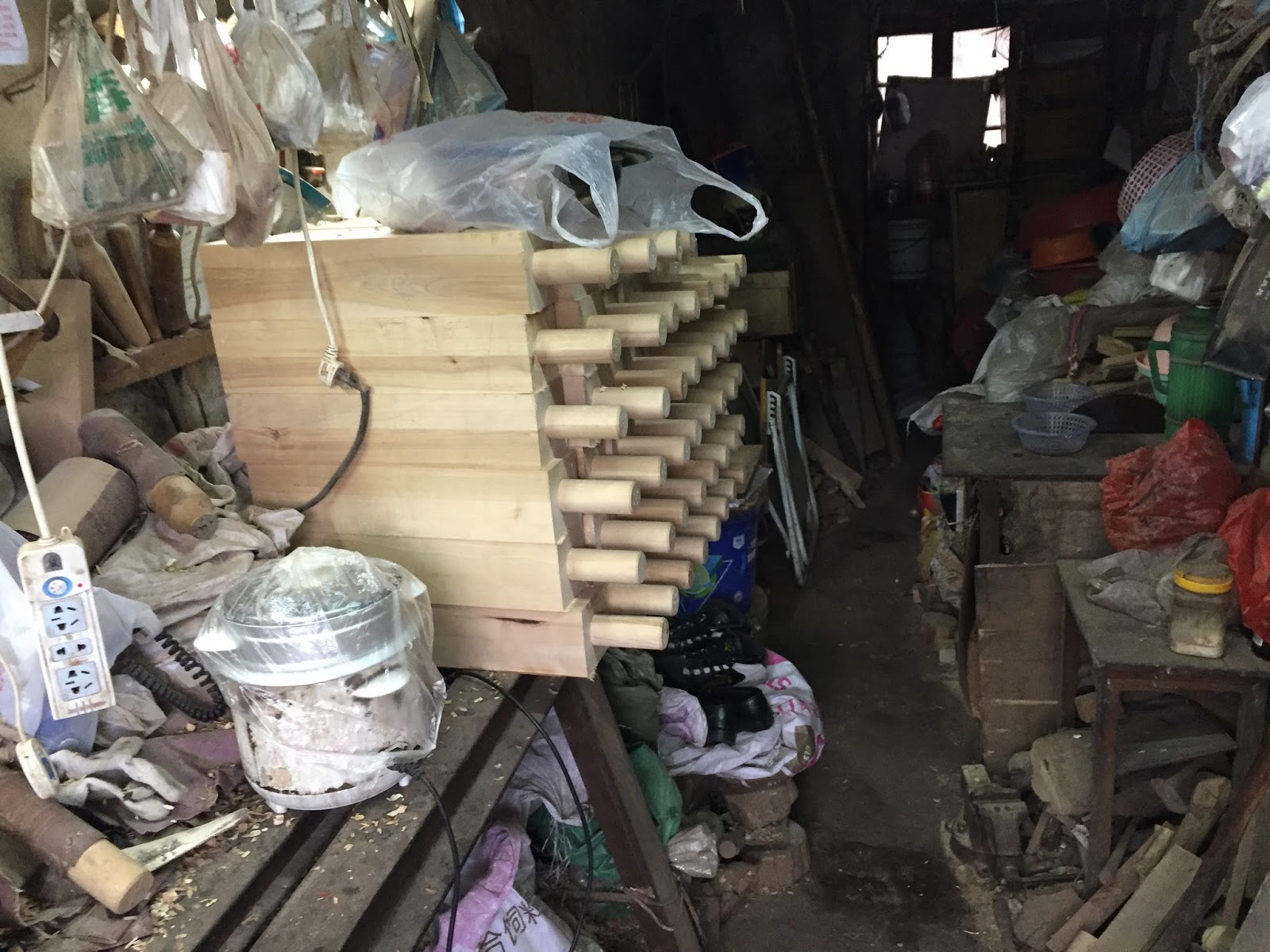
 tablesaw most commonly seen on jobsites
At my request, my wife asked him whether there were any other furnituremakers in the neighborhood. He uncrossed his arms to gesture that there was another turner a few doors down and then settled back into zombie mode. I wasn't able to learn who typically commissioned him to manufacture banisters, table legs, or whatnot. I bought two file handles that he had for sale in a bucket outside his door at 4 RMB each.
 a lot of turned piecework

Handles or turned offcuts


The handles demonstrate the skills of a workman who keeps a pattern in his mind's eye: controlled irregularity. I've had trouble find ferrules in China for student projects. The term in Chinese is, 铁箍,  tiegu. These ferrules, however, appeared to be nothing more than cheap tin. An unapplied example bent more easily that metal from a tin can.
File handles
We walked past the second turner's shop and saw a near copy of the first. Further ahead, we turned into an alley and began walking amidst a neighborhood undergoing demolition, renovation, and relocation of its residents. It's generally unclear what is happening whenever such Haussmannesque efforts are underway. Residents, squatters, and scavengers tend to hold their ground in order to negotiate for higher compensation from the local government.
Cat perch

historical architecture: demolition by neglect
Often the true nature of the renovations are obscured to keep the beneficiaries of public works projects in the shadows. The attitude outside of Shanghai towards historic preservation to demolish down to the bare ground and rebuild in order to make the area 'more beautiful'.  Historically this represent how one dynasty superseded the previous one.
recurring rafter tail detail

Shared courtyard of Republic houses

While it's too soon to say, there might better concerted efforts to preserving some of the preserved elements in this neighborhood. Historic markers identified these buildings as built during the Republic era. It's frustrating to see so much exposed timberframing that could have been preserved even 10 years ago with a minimum of efforts to keep it dry.
Semidemolished housing

Squatters and Squalidness

13 March 2017

Architectural elements: Shanghai spolia

modular units on display
The last few decades have seen cycles of construction and demolition across the mainland Chinese landscapes. This has been most evident in the cities where many urban and prefectural governments finance their operations by seizing and reseizing properties and leasing to developers for denser, higher priced redevelopment.
Windows and shutters against remnants of courtyard wall
This system creates masses of waste as concrete and brick structures get jackhammered on a large scale to be dwarfed by the new construction projects. Often the bricks get salvaged depending on the speed of demolition; more commonly it's only the rebar that gets extracted and recycled. As I have documented before, some structures built during the early years under Mao Zedong possess enough wood materials to justify prying the materials apart before bringing in the bulldozers. The numbers of such structures is disappearing fast as many cities set upon apartment buildings constructed in the 1980 and 1990s for yet another round of redevelopment.
Garret access ladders, perhaps
It was only happenstance that brought me to a Shanghai construction site where I discovered a very well organized sale of architectural salvage. The existence of such a market, which I have observed nowhere else, demonstrates two points. First, the high standards of construction in Shanghai has deep roots and continues in this manner. Second, and perhaps more importantly, there are active buyers for such salvage within Shanghai. I've talked with several Chinese who don't believe that wood is strong enough to be used to build houses! The buyers coming to this lot understand construction methods that have become obsolete elsewhere and notably value the aesthetics and functionality of these repurposed materials.
Lap joints with traces of plaster

Beaded exposed timbers


I don't know how long this sale had been going on when I stumbled across it. There were bundles of tongue and groove flooring in empty storefronts slated for eventual demolition further up the street. (The interiors were too dim to photograph effectively.)
Stacked newel posts

Pilaster with carved motif, tongue and grooved flooring bundles

It's comforting to documents positive actions such as this. For those interested, the address is 612 Kang Ding lu, Shanghai. Prices are negotiable so act now!
Glazed doors

Was this tenon (drawbore) ever pegged?


09 February 2017

Authenticating plastic

There is a trend in woodworking that has been annoying me because I could not adequately understand the appeal and I've had difficulty in explaining the phenomenon as I perceive it. I don't want to write a long expository essay now because I don't have the inclination nor sufficient historical background yet I still want to use this opportunity to describe this trend and to make a prediction.
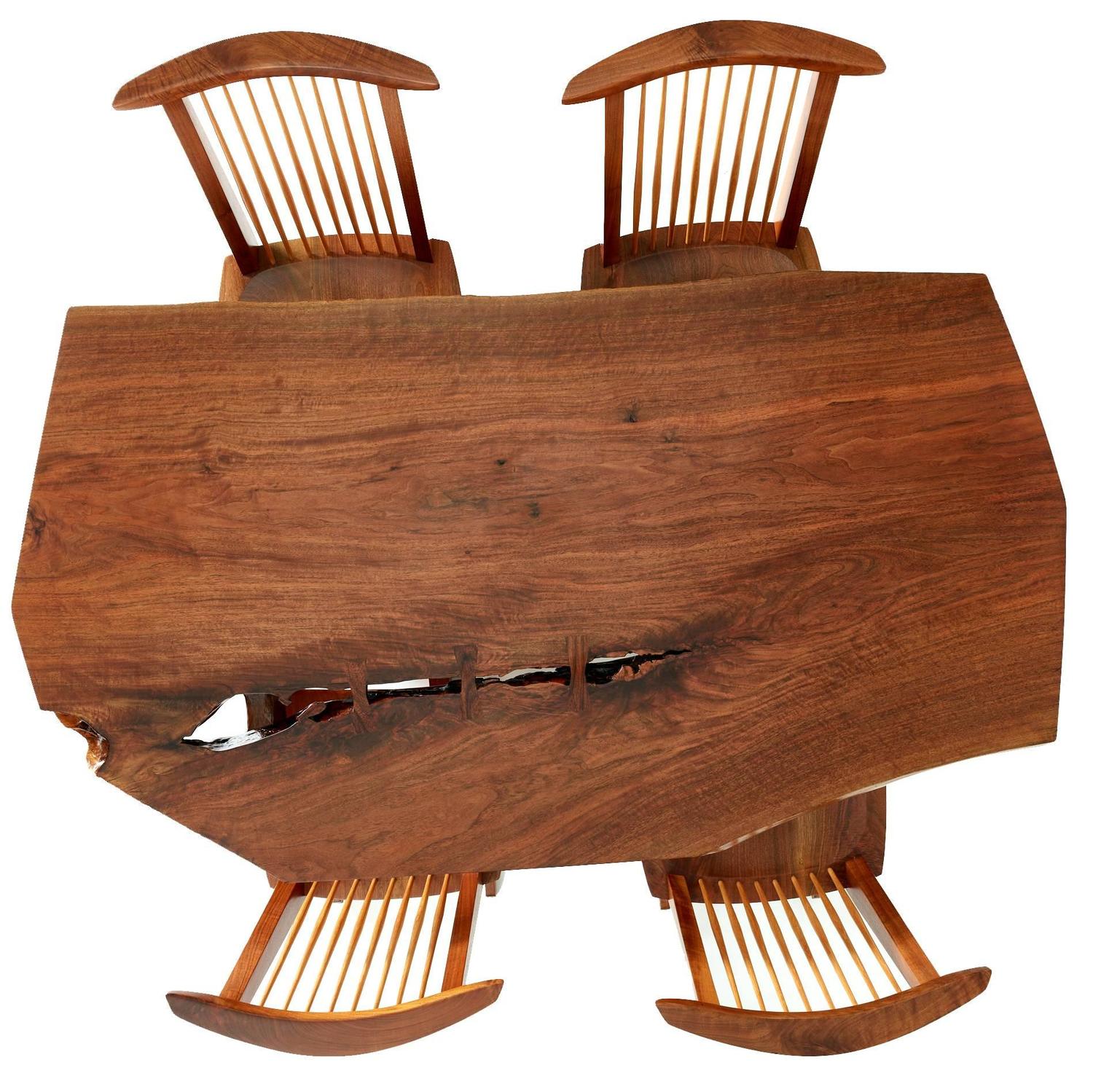
The term 'live edge' has been used to describe wooden furniture with undimensioned edges. Famous examples of this sort of sophisticated rusticity date from before my time on this earth. I think I first noticed it in the work of George Nakashima. Being young and naive, and wanting to rebel against whatever I thought I needed to rebel against, I thought the idea of furniture that didn't quite appear to be furniture was cool. There's something compelling about a piece of contemporary livingroom furniture that still retains features of a raw log that appeals to an SUV driving professional, to a manly salaryman, and equally to an urbane hobbit.
Challenging the limits of what a sawyer can do
As I grew older, more discerning, and less cavemanish, I turned against this style of furniture for several reasons. I realized that these pieces are very impractical to live around. They are essentially oversized sculptures that require their own zones to accommodate them and be displayed in. In such a way, they can enhance the opulence of an already grand mansion since they generally are out of the price range of most homeowners. They cannot be adapted average households nor do they lend themselves to being moved about while an owner chases a career path and relocates his belongings in a Uhaul rental.
The movers are gonna need a lot of bubblewrap for this item

Like rooted giants themselves, these items are massive and made to convey permanence. None other than a Rockefeller was one of the first and most prominent collectors of Nakashima furniture. Not only could he afford to purchase a 200 piece lot of furniture on commission, his inheritance could equally afford the mansion to house them all. Equally, if one has the resources to rebuild a house lost to a fire exactly as it was built in the 1970s and the prestige to have it written about in the NYT, then the high cost of Nakashima is appropriate to one's social stratum. Even a single table merits a wistful essay in the paper of record. This is furniture beyond the price range of most everybody reading this weblog, and those in the club like it that way.
Opulent rusticity for simple senatorial elites
In addition to signifying upper class membership, Nakashima style furniture is more to be thought of as sculpture rather than as utilitarian items. It's not a surprise that so many museums want his furniture since so many original owners must have houses the size of museums to be able to display them. It can be wondrous to look at objects that beguile the eyes with unexpected shapes. It's a table but it also looks like a tree! Yet these chairs and tables with their sharp arrises and untrimmed edges are often uncomfortable to live around. They are certainly not child friendly as if children would be allowed near the Nakashimas! And cleaning a 'live edge' requires more than just wiping it across with a damp cloth. Yes, museum quality to be sure.
Those aren't holes; they're artistic flourishes put there by nature
Members of the upper classes have always wanted to distinguish themselves through material culture. In this respect it should not come as a shock that the gentry choose to flaunt their money and cultivate taste buy purchasing handmade furniture. They want to acquire what others can only look at. This distinction is heightened by the fact that retaining the 'treelike' quality, no piece can ever be duplicated. And as their accountants point out, one of a kind items more likely appreciate in value over time. As much as every tree develops organically, the craftsman imposes less amount of handwork than is seen on mass produced furniture.
more base than tabletop
Born in 1905 Nakashima's fame and income grew steadily after WW2, an era of increasing mass production in housing trends, clothing, and lifestyles. This has echoes with the Arts and Crafts movement that was a reaction to mass production and industrialization in the UK. But the late 19th century craftsmen still didn't have to contend with the creeping imposition of plastics into their trade. Plastics and modern adhesives are essential to contemporary industrial furniture manufacturing and designers attempt in so many ways to obscure this reality.
Color coordinated with the avocado Frigidaire
Growing up I learned that paneling is how walls get covered. 9 groove paneling is 4x8 large sheets of masonite or hardboard with blackened channels running lengthwise and printed to resemble wood figure. Often it was glossy smooth but it might also be textured with raised wood grain. There are specialized color coordinated corrugated nails for this material. It was a fast way for finishing surfaces in expansive suburban built bedrooms for the babyboomer children in the post war years. It was also so cheap and light enough that redoing it was as simple as with repasting wallpaper up.  My mother demonstrated this makeover to me numerous times.
I visited a hotelroom a few days ago to find an interior that seemed to be inspired by the paneled interiors of my youth. It was a challenge to take a photo without catching the reflective glare from the sheen.
Photoperfect wood

Matching floors


Plastics are used to create a faux wood appearance.  I grew up surrounded by this ubiquity and only learned with effort how the original paneling was intended to finish a room interior e.g. wainscotting, which it was putatively based upon. This plasticized ersatz wood is marketed primarilyto the working class. It can still be found in the best appointed doublewides. The upper classes, therefore, want nothing to do with it. A hotel designer can employ it to affect an easy to clean, modernist cachet, which can be ripped out and replaced cheaply when the management wants something new in short order.
Lastly, it is often convenient to flatter the upper class by downplaying their baser financial motives and instead highlighting the spiritual aspects of their investments. The artist and the dealers willingly go along with this pretense.
The slab church missal

In order to counteract this straightforward objective,
''His prices have gone up a lot. At the same time Los Angeles collectors are instructing their decorators to find Nakashimas, you see the best pieces at auction going to Swiss and German collectors and French dealers.'' said James Zemaitis.
we must muddle through pithy platitudes about intangible qualities that only sufficiently degreed art historians and museum curators can typically compose.
In Nakashima's own words:
''We work this material to fulfill the yearning of nature to find destiny,'' he said, ''to give this absolute inanimate object a second life, to release its richness, its beauty, to read its history in life.''
His own daughter, who, since her father's death, has taken over the Nakashima brand, offers a metaphysical salespitch:
''Work for him was a spiritual calling, a linking of his strength to a transcendental force, a surrender to the divine, a form of prayer,'' his daughter, Mira Nakashima,...
From the same article lastly comes this more businesslike assessment:
Mr. Aibel specializes in Art Deco antiques, but he has also been the premier dealer in vintage Nakashima furniture since 1985. ''By my estimate, George Nakashima made about 25,000 pieces in his lifetime,'' Mr. Aibel said. ''I've handled some 2,000 of them.'' Tomorrow evening he is the host of a book party for Ms. Nakashima.
Nakashima's work will also be seen at Sanford Smith's antiques show, ''Modernism: A Century of Style and Design,'' which opens in Manhattan on Thursday (through Nov. 16). There will be several pieces in the Moderne Gallery booth, with prices from $7,500 to $35,000.
Dead artists make for great investments. Get in while the getting is good, people! The time to buy is now. 
George Nakashima coffee table up 34% on estimate at Skinner
Over time the aesthetic sensibility of their betters has trickled down to the tastes of the masses, too, who are comforted by easily identifiable 'real wood'. I encountered some of this when I once suggested that milk painting was an appropriate surface covering for some student projects when I was still working at MYLab. To a man, the novice woodworkers wanted only to finish their projects with oil so that they could 'see' the wood. This phenomenon is also played out in Shaker revival furniture. The Shakers, a preplastic celibate cult, were quite happy to brightly paint their interiors and pine furniture. In the revival movement, however, the emphasis is on the clear finished pieces. The Windsor chair form has also experienced a revival but with the exception of a handful of craftsmen who make the furniture entirely by hand and apply milk paints accordingly, the commercially made items are often treated with a clear finish with mixed and jarring results.


Real wood but not too much

Disunified but reassuringly 'real wood' for the masses


Recently this emphasis on 'real wood' has gotten a boost from a woodworker who moonlights as a television actor in his spare time.  Finally an entrepreneur has made Nakashimas for the working man's wallet.
Offerman in the style of Nakashima
Finally, I was recently prompted to articulate these disjointed ideas by a visit during Lunar New year to a Shanghai stationery shop with its own cafe.  I saw the tabletops in the late afternoon sun and was initially deceived into believing that they were built with rough sawn planks.
Surface detail
Oh, the versatility of plastics! I had to look at the end grain to be fully clear about the matter.
Patterned to deceive

Endgrain in plastic is still to be avoided


The manufacturer had moved up to the next level, not only reproducing the figure of the wood, but also the texture from a coarse bandsawn blade. It's an homage to the Nakashima cult by intentionally making a table that is more difficult to wipe clean. But in melamine for the coffee swilling masses!

It is only a matter of time before the next step is to be achieved. I predict that we will shortly see more examples of this trend to recreate 'real wood' industrially using plastics in the manufacture of Nakashima style furniture. And so I wonder: what then will the upper classes turn to in order to fill out their palaces?

Are there possibly any others who share my blasphemous viewpoint?

31 December 2016

Some Like it Warm

While waiting for the local woodmerchant to get back to me about the inventory SYP in the bigger warehouse, while waiting for a new consignment of lumber to arrive through the port of Shanghai, while waiting for the woodmerchant to find what he considers a quality selection of NanHuangSong Mu, while waiting until after the Lunar New Year, while waiting for some trees in rural Georgia to be milled into construction lumber, I was inspired to add a weblog posting in an effort to appear productive.
I've been following Greg Merritt's weblog, Hillbilly Daiku, as long as I have been writing about my woodworking ventures in the PRC. I vaguely recall first finding his postings about knots and making a fid. And more recently he wrote about his hide glue pots. Certainly one of the impediments to any woodworker adopting hide glue is coming up with a method of keeping the hide glue at proper temperature with a controllable heat source. The days in which an apprentice lad would put the glue pot on the potbelly stove, which he began tending before the tradesmen arrived, are in the realm of nostalgic lore, pace George Sturt.
With my first attempt to work with hide glue, along with a passel of other secondhand tools, I had bought an aluminum double boiler from Ray Iles. I had to run upstairs to fetch the the pot from the gas stovetop. There was no lid and the chilly basement workspace gave me about 30 minutes of working time before the heat had dissipated and the glue pot needed to be returned to the stove. It was the best that I could manage at the time. Hide glue was something that I had only read about and while there were (and are) some purpose built appliances for crafts that require hide glue, notably making stringed instruments, in the incipient Internet era, they were harder to find and out of my price range. 
Merritt, after buying a hide glue pot and warmer set offered by Lee Valley, decided he needed to go to the trouble of converting a wax warmer into a hide glue warmer. After confessing to Amazon's subliminal marketing scheme to impoverish us all, he read about the setup on on yet another woodworking weblog!
I think I could have saved Merritt a bit of cash. I'll explain the setup that I have been using for a few years now. It's interesting that a wax warmer might be so much cheaper than a warmer specific to warming hide glue. I believe that this speaks to manufacturing concerns pursuing the latest aesthetic depilatory craze. An electric appliance that maintains a constant temperature for liquefying wax or reheating hide glue ought to cost about the same price when brought to market. Instead, the former is $29.99 and the latter is $134.99. 
While I'm very much in favor of personal beautification, I chose to adapt my needs to an appliance that is manufactured on a large scale and more broadly used than even wax warmers.
Standard Office Appliance
 As you can see from the photos, this tea cup warmer looks very much like the warmer sold by Lee Valley. I cannot vouch for the comparative quality of its construction, but I have been using it for more than two years. It is preset at 60* Centigrade, a perfect 140* Fahrenheit for maintaining hide glue at workable temperature. Any such product sold abroad would be required to meet higher manufacturing standards for that market. 
Suitable for tea cups or coffee mugs
The tabletop warmer from Lee Valley sells for a mere $9.50. If I were not in China, I would buy that and then do as both I and Mr. Merritt have done: use lidded glass jars for the hide glue containers. In fact, if one looks carefully at the LV warmer, it's clear that is larger than necessary for the diminutive glue pot (1oz.). I use wide mouth, repurposed jelly jars (usually) to act as glue pots. At the low price of free, I can even afford to have two in use at any one time, soaking a new batch of the hide glue pearls in a refrigerator when I notice a low level of a working batch.
The lowcost setup minus hide glue
Another common Chinese appliance that has served me well for woodworking is an electric kettle. On days when I anticipate using hide glue, I remove the hide glue from the refrigerator and set it on the warmer. It's a slow organic process so that I can plan on having the glue ready for use in two hours' time or less.  Before I am about to apply glue, I turn on an electric kettle to have some boiling water handy. I usually fill a disposable cup (since they were available at both locations where I worked) and preheat and soak a brush before inserting this into the hide glue.
There are few demonstrable benefits to this method. Putting the brush into hot water keeps from chilling the hide glue down from repeated dippings. The hot water makes adjusting the viscosity part of the application process. If I need to repair a crack or let some hide glue trickle under a poorly clamped bit of veneer, I first let a thin stream of hot water invade the seams. The moistened and warmed surfaces better ensure that the glue flows inwards more deeply. Lastly, the hot water on hand makes any stray glue drips or misapplication simple to clean up. 
Lastly I never rest my brush in the hide glue and I rinse it clean with hot water after every use.
Where the original was cast iron, this one doesn't cost $47.50.

Lastly, happy and prosperous new year to all.