Showing posts with label Ming era. Show all posts

03 July 2018

Making bridges from Boston, to Jinze, and back to Saalburg

Detail view of 清明上河圖
I have the vaguest of recollections of watching the original Nova episode. It was a lifetime ago and I've watched so many interesting programs made by Nova that I might be mistaken. Somewhere, however, in the back of my mind, I have had some desire to track down this example of reconstructive archaeology and gaze upon it firsthand. I rewatched the episode to gather enough clues to help my wife track down its location, Jinze.
Canal front in Jinze 金泽镇
Jinze itself merits a visit all of its own. It's a network of canals and a showcase of timberframed and brick courtyard structures that are in desperate need of sensitive preservation and historical documentation. It has so far escaped the commercialized rebuilding that happens to all designated tourist destinations. Throughout the area, I spotted several signs conferring historic preservation status to many buildings, all with the date of 2017. There is hope and dread as to how the Shanghai government decides to manage this treasure on the past.
There are no garish pointers leading travelers to the new rainbow bridge.  My wife asked a shopkeeper who gladly and patiently explained which canal to follow to reach the bridge. It has been nearly 20 years since the NOVA crew was there and I wanted to see how the structure was holding up. The documentary mentions that this style of bridge had stopped being built and so I wanted to do my own follow-up. On our way there, a woman approached us, ostensibly to offer us a 'gondola' ride along the canal. My wife explained what we were looking for and she proudly led us there; she ran her boating business from a structure right next to the bridge.  My attention was divided between a very interesting cabinet that stood outdoors and getting a better look at the bridge.
Integrated lock mechanism

Iron ringpulls on a foodsafe


Immediately all the woven timber components stood out to my eyes that they were of the same diameter. I knocked on one to confirm my suspicions. The originals had been replaced with iron pipes. Despite not being an engineer, I suspect that this is not the best way to use iron in bridge building. The boatwoman explained that the bridge started to show signs of decay in the second year. In the fifth year, the bridge needed replacement, by which I interpreted to mean that the pipes had been substitued although there are still a few wooden beams rotting in place. I doubt there was any report as to what caused the failure nor further research for how to better make a rainbow bridge. A facsimile was made using pipes to sufficiently copy the appearance. I also suspect that the present day decking has also been replaced on more than one occasion, its appearance is nothing as was shown in the NOVA program.
The gondolier was a very welcoming hostess, filling our ears with her civic pride. 
Upstream view with fallen timber

PBS Nova stele

underside view

downstream view

I was glad to have found the rainbow bridge and see that some of the NOVA project was still in effect. But it's evident that there is no more interest amongst the Chinese scholars for working with this model.  This destination is not a major attraction for tourists, most of whom were retired Chinese traveling with their danwei more interested in a boat ride and singing patriotic songs while taking photos of riverside views as my wife disdainfully pointed out. The red painted views of the bridge with the lion medallions seem mainly for their appreciative viewing. I mention to point out that this international experiment in reconstructive archaeology is today just another bridge among many that are necessary for this canal city. So what are the results of this experiment? Did it function as such bridges commonly once did? What can one conclude from its short utility? Is there something about the design or material choice that might have prolonged its lifespan or does the rotting explain why such wooden bridges were eventually replaced with stone structures? Does it, in fact, say more about present day Chinese workmanship where nothing is built to last very long.  It's sad and disheartening because there are extant examples of such timbered bridges that have lasted much longer than the Jinze bridge.
Ready for another rebuilding

Chinese bailer twine

persistent dry rot

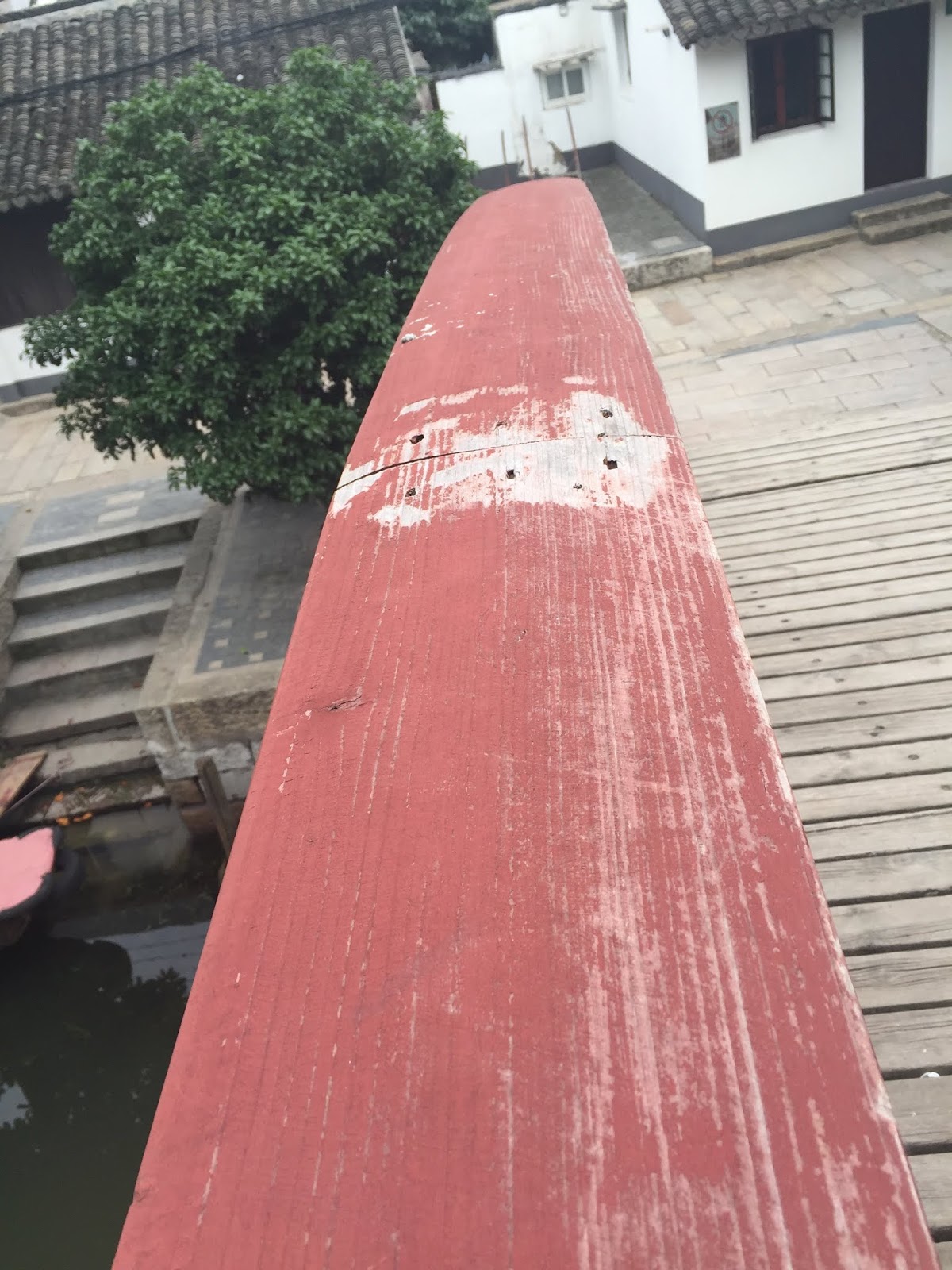
Cambered railing

This opportunity might have led to a deeper understanding of how to recover traditional, and evidently more effective methods, but the opportunity has been squandered. On so many levels, this bridge represents modern construction within the Chinese context. I feel as though I've seen examples of this bridge in all new construction. I can only add to this by pointing out how strongly motivated the Chinese are by literary and artistic paradigms and their adherence to copying them. On another level this construction is a copy not of a bridge but of a painting. And as much as paintings are merely interpretations of reality, this bridge is an image of a Chinese tradition that was codified by the painter on the Qingming scroll. It continues to be copied on many media right through until today.
enjoying the golden years

A copy of a copy of a copy in silk embroidery suitable for framing
In this respect, the Jinze bridge needs to only look like the picture bridge that inspired it; it needn't function as a woven timber arch bridge.
I couldn't have predicted all that awaits to be explored in Jinze. I plan on posting another essay highlighting the many architectural gems that can still be detected and admired here and there, but I shall end this essay with one last unexpected discovery.  One result of the takeover in 1949 was that formerly large courtyard houses were split up into smaller units, effectively turning the courtyards into public throughways.
Street sign indicating 9 addresses
This pattern is repeated in many places. I was at first reluctant to walk down such streets that were once private corridors.  Sometimes a foreigner can get away with doing such things because locals are reluctant to confront a western face. They gawk but they say nothing. In this case, I was not an intruder since I was walking into a public space. Long live the Communist party!
Publicly liberated opulence
Following deeper into the passage, I glanced up to spot this carved beam and arched roof. It immediately spoke to me as to the precarious nature of so much of Chinese traditional architecture. I had to lighten this photo to make the details visible. As I was angling my iphone to get the best lighting, my wife shouted that there was a bench.
 noteworthy workbench hidden in plain sight
Even she could recognize its general form as a woodworking bench, yet I was dumbstruck by how much it resembled a Roman bench from Trier with many of the holding devices that Christopher Schwarz has been documenting and recreating. I had to tweak these photos since this covered area was also dark.

end vise with missing hardware

broken dog in dovetail housing

Crochet and bench surface
I have no idea why such an artefact was left in this public space. It might have been used to build the original dwelling. There are plenty of tool marks and some hints of a tail vise.  It's too well built to be used by a contemporary carpenter who typically nails together a flimsy table that is abandoned on the worksite after the job is done.  This bench has mass of thick timbers and might have been left in this location because it's too heavy to carry away and too thick to be chopped up for firewood. And so, Mr. Schwarz, do you think you see an example that is worthy of replicating?
one style of a Chinese planing bench

This bench presents a mystery since it doesn't appear to follow in Chinese traditions. The next post will show more of Jinze.

09 June 2018

Table Forms and Wood

This essay was inspired when I looked over this table that seems to be a commissioned piece. I've been working in a new situation in the Qingpu district of Shanghai. I'm still growing into this work environment and adapting to the circumstances.
Wood and metal
This is certainly part of what the market demands and woodworkers can happily supply. I've written before about why I think there is an aesthetic by which consumers need reassurances that they possess 'real ' wood. (More on this to follow) This explains the use of slabs and wane, now marketed as 'live edges'. And that is what this table represents.  It's a hunk of solid wood mounted on four welded leg assemblies. While looking over this piece, I thought about how odd it was that the legs were screwed up into the slab, flush with the corners when the piece would have looked better if the legs had been tucked just under the surface, hiding the low quality welds from direct view. I was looking at this table as a westerner but this was a table in the Chinese style despite its modern aesthetics. For those who are unfamiliar with the concept of Simianping, here is an example that I spotted on a sidewalk in Jinze.
Box with legs: Chinese table archetype
The table is a box in overall form. Another term for this is corner-leg construction and it is embedded into the Chinese psyche as to what a table ought to look like. And this mental model goes far to explain why the maker of the table above felt compelled to create the resultant form, which, despite being trendy and modern with its 'real' solid wood tabletop, maintains a very conservative Chinese root. As it happens, I came across another example of a table that displays a mixture of conservative and modern construction with its own results in compromise.
Just around the corner from the Chen Yonggang Woodcraft Studio is a cafeteria that is frequented by me and my coworkers, which is where I discovered tables that imitate simianping. Understandably the joinery is greatly simplified, in part to keep construction costs down, but simply because HongMu joinery requires dense tropical hardwoods to succeed.
Waisted, simplified, corner-leg construction
 As I have written before, one weakness of Simianping is the panel and frame tabletop assembly. This makes such a table difficult to clean since water unavoidably seeps into its gaps, compromising the joints and filling them with crud and schmutz, which is just the kind of situation that one might want to avoid in a busy restaurant when choosing tables to serve customers. Yet again the archetype of what makes for a 'good' table trumps the functionality of any specific tables.
Faux panel and frame construction
I just wonder what process was used to cut such a narrow groove along and across the grain.  Impressive even as it only adds difficulty to a busser's routine tasks.
A popular restaurant chain that happens to sell furniture
I think this points out a chicken or egg dilemma. If a laudable goal is to put better constructed furniture on the marketplace, is it better that consumers are educated about furniture construction, or is it more advantageous for manufacturers to build such furniture in anticipation of attracting consumers? In the long and short run, my opinions is that consumers primarily determine with their purchasing decisions what manufacturers respond to. Better informed consumers push standards higher (certainly in the absence of guilds, or selfimposed industry guidelines, or governmental regulations) It's, therefore, frustrating, in particular, when manufacturers mislead or exploit consumer's own confusion with their furniture designs.
Magical trees go into its manufacture
I first spotted this coffeetable at Ikea but I only single this business out because I spend so much time there. Deceptive design is not their exclusive domain. This is their Stockholm table, which the website refers to as made of Ash veneer. I apply veneers to many of my pieces, but this type of example is one that has given much of the general public a alse notion that veneer is a sign of low quality construction in furniture.  I've heard this stated with confident authority and it explains much of the 'big slab' furniture aesthetic, which unsurprisingly this Stockholm is trying to imitate even as it also is fooling most consumers.  I don't have any problem with the application of ash veneer and even though end grain veneers present their own challenges, visual and adhesive , they are not the thrust of my objection to this piece. I object to cheating the consumer into believing that this is made with staked construction which is associated with solid wood. The through tenon, again a weakness as explained above when it comes to routine cleaning, overtly misleads that the solid leg passes through a solid wood tabletop, which to a casual observer the veneers create a false impression that it is. What is the purpose of the choice of exposing through round tenons but merely to confuse a potential buyer (it certainly offers no structural advantage) even as it compromises the veneered surface from normal use. It's an example of a manufacturer exploiting ignorance and capitalizing on it in a race to the bottom. Caveat emptor et aut disce aut discede Ikea! And yet this is not the only example that I found during my visit to buy a needed coffeepress.

I struggled to get the proper raking light necessary to highlight the travesty of this design feature on the Industriell line of table, bench, and side chairs. Whereas, the Stockholm is described as 'ash veneer', the Industriell table is vaguely described as 'light grey' both as to material and color.  Even though my VPN routed me to the UK Ikea website, I presume that 'light grey' is intentionally obtuse in all versions of English. And all because they don't want to state that the pieces are made from pine laminate. And to further mislead consumers, the surface is somehow treated to resemble a rough sawn surface as though it came directly from a sawmill as a slab! Is the greater sin miseducating the general consumer or exploiting his lack of consumer acumen? By the way, the underside of this tabletop is perfectly smooth, the kind of smoothness that one wants on a tabletop to help keep it clean. And yet this faux rough sawn surface is put proudly on top, the direct opposite that one would do in traditional construction. Are manufacturers really so exploitative of consumer ignorance or are designers so far removed from traditional woodcraft that they blithely turn a flaw that was once dutifully hidden in construction into an industrially fabricated feature to deceive consumers?
Can a sawyer ever do this?
And if you thought it could not get worse. My last criticism is for the the Hurdal linen cabinet. This piece first caught my eye on a showroom floor because lacking a plinth, it looked oddly squat. Its proximity to the floor is the least of its flaws.  I don't know whether the Hurdal is marketed in all countries with the tag below: 
a tree, a common source of wood, as imagined by a designer
It doesn't take very long to find example that contradict this assertion. Or is the goal, in fact, to redefine what solid wood is? As long as consumers fail to educate themselves, it only follows that salespeople and grifters will dazzle them with their marketing strategies regardless of the reductions of language and functionality that are the results.
definitionally unsolid wood for the drawer bottom
The piece is rickety and it's probably due to the manner in which 'solid wood' is used less as a structure element than as a meretricious feature. The piece uses solid wood gliders, which might be an improvement on the more common stamped steel glider. And yet for some confounding reason, the manufacturer undermines this refinement.
Profiled beech glider component
In order to simplify assembly, or perhaps manufacturing and packaging, both left and right sides of the drawer are identical. So while the drawer sides are made of solid wood, albeit, industrially laminated, which is potentially an improvement, they are needlessly milled with grooves that serve no function and render the drawer construction weaker.
Double milled in vain

Needlessly grooved, so ungroovy


I don't know whether Ikea has had to answer any criticism about this, officially from its headquarters or from its own salespeople. A real designer would never deign to respond to such a query I suspect that a spokesperson will emphasize that it's made from solid wood (!) and that it can be more easily assembled by those who don't know their left from their right hands. Solid wood doesn't mean any more what I thought it did.
Duanwu jie kuaile!

05 May 2018

Shaker style New Lebanon worktable


'lifted' ends
I don't make a habit of incrementally posting updates throughout my buildouts. I approach every posting from this side of the great firewall with a bit of frustration and a modicum of dread. Having to negotiate blogspot.com with an unreliable internet service and mandatory VPN means that basic postings require more time than is necessary for those outside the Middle Kingdom and there is always the lingering potential to unexpectedly lose data. I have wondered whether posting more often might increase comments or having more commenters might more likely increase my willingness to post. Chickens and eggs.
I had been playing with the idea of a drawered table for a time but I wasn't fully sold on a design until I came across the example from the Metropolitan Museum. I had seen corner tables with drawers on two adjacent sides but this example convinced me to take a plunge. Knowing the overall dimensions made it fairly easy to determine the other essential dimensions with a set of dividers and a large printout.
the starting point of the build
Museum curators generally focus on external appearances even when the internal details are the greater focus of interest for woodworkers. I am confident enough to aver that I can recognize best practices of drawer construction, both from reading and from having repaired antiques. Before making this piece, I was less confident with knowing what best practices are with regard to what the drawers are pulled out of and slid back into. The most basic method is a box inside a box construction. I've been also making some 'spice cabinets' and so this method has been at the front of my mind. Scaling up from such a small cabinet requires a different approach. Modern woodworking practices have all but abandoned wooden construction in favor of metal slides. The main advantage I can see to these devices is that they do not allow for pulling out a drawer too far. The photocopy above shows a few construction details but also leaves many out. One can see the bottom runners that support the middle drawer. I also deduced that the kickers for this same drawer are the bottom rails which support the two smaller drawers. This double duty of one element is just one appealing aspect of this design. There were still more internal details that needed to be worked out as work progressed.
the single piece runner and guides
My first innovation was to make runners and guides out of one rabbeted piece. Most often when doing repair work on antiques these the guides and runners are found to be nailed together and to the interior. In general, I want to avoid this shoddiness. Starting with the center drawer, I aligned and cut the guides to fit between the legs and then inset the the runners into dadoes in the front and back legs, securing the pieces to the front legs (where greater stresses come into action) with a single 5mm screw in each and only gluing into the back legs with hide glue.
I then cut the runner section of the similar rabbeted length to fit between the spaces of the lower rails, letting the guide portion merely touch the legs. These were attached with 8mm dowels, using dowel centers that I bought in Amsterdam.
Shaker refinement
In keeping true to the high standards of Shaker craftsmanship I turned tapered drawer pulls, using a tapered deburring tool. A fluted reamer would likely leave a smoother surface but this tool, nonetheless, is adequate. I left enough length to allow a compressed fit with just a touch of glue to hold the joint together.
I made a few changes that, I believe, are worthy of mention. I added a beaded edge to the bottom of the rails. I think it just looks better, giving a clearer visual cue. The original piece is assembled from a variety of wood species by a craftsman who knew their properties and how to select the best pieces from a much better quality lumber supply. I used the best of the SYP stock that I have on hand and some hard maple that was sawn in Dongbei some time ago, (The woodshop chief bought a large pallet of it because much of it is spalted.) and a limited stock of German red beech. Clear, straight grained maple was selected for the legs; whereas, the original has cherry (by eye).
maple on maple
As anybody who has repaired antique case furniture quickly learns, one weakness of drawers is that the sides, usually made of softwood to reduce weight, are worn down from years of being abraded across hardwood rails and runners. It's a routine repair to remove the sides and attach new wood to replace this loss. I decided to forego this eventuality by gluing a strip of maple along the bottom of the sides before milling them to final dimensions. It remains to be seen how well this solution benefits this piece. A hundred years of in and out will bear witness.
Since this is a worktable (of an unspecified function), it's understandable that the original tabletop was made with reinforced edges. It also has a raised lip on all four sides that appear to meet at mitered corners.  I don't need a raised lip and I considered attaching a breadboard end of hardwood, which is still an option on any additional pieces. Somebody using the woodshop for an order of beech tabletops had left a bundle of beech strips that I pulled from the waste and happily applied to strengthen the sides.
                                    {insert expository photo here of innovative design feature}
From one of the Metropolitan Museum's online photos, there appears to be a stop that prevents accidental overwithdrawal.  (It's a word!) I started to think about this (safety) stop as well as backstops. I eventually decided to simply focus on the backstops. Since it's not a typical configuration to have two opposing drawers in case construction, the goddess, Moulariprionia, blessed me with this inspirational solution. I surface planed a length of maple stock to a thickness that snugly rested between the backs of the drawers so that they both were flush with the exterior. I then cut out recesses, scribed and centered from the inside dimensions of the long upper rails.  Onto the upper projections I pared tapered slopes into one side, which was then used to transfer the receiving mortises. After sawing into the rails the mortises were fully chopped out. Thus one piece was made to function as backstops for two drawers and a support for the tabletop.

the only backstop available for viewing
I swear I took a photo of this joinery before screwing through the upper rails with three screws on each end, the two screws on the left and right driven into crossgrain slots, into the tabletop, which would have made this wordy description moot. Praise the ongoing mysteries of the goddess!
a handy angle drive
I know from experience that backstops on bottom rails can lead to problems. Many backstops bang up against a small surface of the drawer sides. I decided that it is better to spread this force across the drawer back as with the above example, which inspired me to simply attach a length of pine, properly thicknessed and tested with double sided tape, to a rail with hide glue. In a hundred years or so, we can evaluate its effectiveness. Lastly, the piece received a beeswax finish cut with linseed oil and mineral spirits.

Simianping with drawers
Symmetrical profiles
I thought it would be instructive to examine a simianping that has been gathering dust in the woodshop. I can only suspect that the woodshop chief owns this table but he is as indifferent to its condition as its previous owners. While there is excessive water damage to both feet and top, it manages to hold together despite the many nails that have been pounded into it over the years in vain efforts to repair it. After my rescuing the simianping that was set to the curb, I was interested in this table to learn how the drawers were made and inserted into the structure.
bottom boards and drawer runners

deep socket halfblind dovetail construction

My intention is not to diminish some of the esteem surrounding Ming style furniture construction, but if these photos have such a result so be it. I looked at all four drawers to be certain that I had not pulled out an odd one of the four. The bottom panels have grain running lengthwise front to back locked within plowed grooves as with the tabletop, as with the tabletop, some sides have shrunk leaving gaps. The drawer fronts have deep socket to receive the sides that pass very loosely into their opening.
drawer with bin pull
Paneled drawer bottoms

It was a challenge to photograph the interior due to the low light levels in the woodshop, but honestly, there is nothing to see. The underside of the table is thin deal also trapped into grooves. This surface is all that supports the drawers, one big empty void that the drawers enter and exit. If it's anything, it's simple.
superfluous and problematic extensions
Two additional points are worthy of mention. Very often drawers on Chinese furniture are constructed with sides having an extension at the bottom which is then trimmed for a final fit as a backstop. In some examples I have seen, the extensions are nearly as long as the rest of the drawer so that they might also function to prevent overwithdrawal. Despite the complete absence of anything for these extensions to butt up against, the craftsman added them to all four drawers. Many have been snapped off so evidently this projection represents a weakness. I hold the opinion that the craftsman who made these drawers, the same worker or another working alongside the principal builder of the table, made all drawers in a perfunctory manner, bound by conservative tradition, despite the additional labor and material.   
a pony hoof
There is a common feature of Ming furniture legs that is referred to as a horse hoof, 马蹄脚. This can be compared to a reverse cabriole leg, lending visual weight to the base while maintaining an overall cubic form. It is an extravagance on one level because a much larger stock piece is necessary from which much wood of the leg is cut down to create the horse hoof. This detail perhaps is a frugal innovation or because a sufficient stock piece couldn't be obtained. It has indentations shaped with a curved rasp. It's effective in its execution.

historical advertisement

Promotional calendar

vintage cheongsam

A short time ago, my wife invited me to an exhibition in the Jiangsu Provincial Art Museum. I went along mainly to humor her, expecting very little from this outing as from any museum in China. As it happened, I was pleasantly surprised by a display of early lithographic advertisements from the early republic that detailed the evolution of the modern and modernizing cheongsam which is based on a more squarish Qing era qipao. I strongly suspect that this collection was curated by a Shanghainese due to its high quality although the display notes were only in Chinese. Nearly all the advertisements appeared to be from Shanghai businesses.
Chinese museum quality furniture
Amongst the dresses, calendars with pretty ladies, and vintage artefacts was a full display of a household interior that featured a sort of dressing table. What caught my eye was the poor state of this desk's condition. Not only was it uncleaned, it showed damage and significant loss. I don't want to speculate but there is, in my mind, a connection between the casual state of disrepair in this museum display and the disregard for a table built around the same era (note the similar bin pulls) and neglected in a dank parking garage.